Key takeaways
- Compare the best slab rollers for pottery, from hand-crank tabletop presses to a guided rolling pin set, with specs on width, thickness range and build.
- Top Pick: JIAYOFWCHI Hand Cranked Ceramic Slab Machine
- Runner-up: Banfluxion Manual Portable Slab Roller Machine, White
- Also consider: Banfluxion Manual Slab Roller with PVC Tabletop
A slab roller turns a lump of wedged clay into a sheet of even, repeatable thickness, and that consistency is what keeps tiles flat, boxes square and platters free of warps. Hand builders who roll with a pin and guide sticks can get close, but a tabletop slab roller does it in one pass, with the clay compressed rather than stretched, so slabs dry more evenly and survive the kiln with fewer surprises.
The catch is that the studio names most potters know, such as Brent, North Star and Shimpo, sell almost entirely through ceramic suppliers. The slab rollers actually listed on Amazon are compact tabletop machines from marketplace brands, plus dual-purpose presses that also serve printmaking. This guide compares five of those listings on the specs that decide a purchase: working width, thickness adjustment, table surface and build, so you can match a machine to the size of work you make.
As an Amazon Associate, we earn from qualifying purchases.
Quick Answer
For most home potters, the JIAYOFWCHI hand-cranked ceramic slab machine is the balanced pick: a dedicated clay press with a roughly 12.5 inch working width and adjustable thickness in a footprint under 20 inches. The Banfluxion white aluminum model is the sturdier premium option, the Banfluxion PVC model and PreAsion press cover small work on a budget, and the AHIER guided rolling pin set suits beginners.
JIAYOFWCHI Hand Cranked Ceramic Slab Machine

This is the one machine in the group sold purely as a clay slab roller, and it is the natural starting point for a home studio. A hand crank drives the roller across the clay, and the gap adjusts so you can roll anything from thin sheets for lanterns and cups to thicker slabs for boxes and platter bases. The whole unit is small enough to live on a workbench and light enough to move when the table is needed for something else.
Because it ships from Amazon and is built around pottery rather than printmaking, it avoids the compromises of the dual-purpose presses below. The listing gives full product dimensions and weight, which makes it easier to plan bench space than most listings in this class. Treat it as a mid-range machine: more capable than the small presses, without the heavier frame and larger table of the premium pick.
Specs
- Type: Tabletop hand-crank slab roller for clay
- Working width: About 12.5 inches
- Thickness adjustment: 0 to 30 mm
- Product dimensions: 19.21 x 10.24 x 8.11 inches
- Item weight: 16.2 pounds
- Tier: Mid-range
Banfluxion Manual Portable Slab Roller Machine, White

The white Banfluxion is the heavy-duty end of this group. Its table is a 10 mm high-strength aluminum alloy panel with an anodized finish, the upper roller is mirror-polished steel pipe, and the handwheel is cast iron, which gives the crank a steadier, heavier feel than the lighter presses. The table measures about 13.1 by 19.69 inches, so it handles a wider slab than the smallest models while still sitting on a bench.
It is sold as a printmaking and pottery machine, and potters use this style of press for clay slabs, texture work and slab-built forms. The rigid panel matters for clay: a flexing table produces slabs that vary in thickness from edge to center, while a stiff aluminum plate keeps the gap honest across the full width. If you roll slabs every week rather than once a month, this is the premium pick of the five.
Specs
- Type: Tabletop manual slab roller press
- Table size: 13.1 x 19.69 inches (328 x 500 mm)
- Machine size: 19.7 x 16.9 x 14.6 inches (500 x 430 x 370 mm)
- Table material: 10 mm aluminum alloy panel, anodized
- Upper roller: High-strength steel pipe, mirror polished
- Handwheel: Cast iron
- Tier: Premium
Banfluxion Manual Slab Roller with PVC Tabletop

The second Banfluxion uses the same press layout at a simpler spec: a PVC tabletop panel of 19.7 by 12.6 inches, a roller 11 inches long and 3.9 inches in diameter, and four anti-slip feet whose height can be adjusted to level the machine on an uneven bench. The roller height adjusts to roughly 1.57 inches, which covers the full range of slab thicknesses most hand builders use, from thin tile sheets to chunky sculptural slabs.
A felt sheet the size of the panel is included, which protects the table surface and gives the clay something to grip. As a budget machine it asks you to accept a PVC work surface instead of metal, so it suits occasional slab work, classrooms and shared studios where the roller comes out for a project and then goes back on a shelf.
Specs
- Type: Tabletop manual slab roller press
- Panel size: 19.7 x 12.6 inches (50 x 32 cm)
- Roller size: 11 x 3.9 inches (28 x 10 cm)
- Roller height adjustment: Up to about 1.57 inches (4 cm)
- Included: Felt sheet, 19.7 x 12.6 x 0.2 inches
- Feet: 4 anti-slip feet, height adjustable
- Tier: Budget
PreAsion Etching Press and Slab Roller
The PreAsion is the smallest press here, with the same 11 by 3.9 inch roller format as the PVC Banfluxion in a compact frame sold mainly for etching and printmaking. Presses of this design are also used to roll small clay slabs, and for a potter whose work is tiles, coasters, jewelry dishes and test pieces, the small footprint is the point: it clamps or sits on a corner of the bench and stores in a cupboard.
Be clear about what you are buying. This is a press first, so there is no canvas, no clay-specific accessories and a working area that caps your slab size. Within those limits it delivers even pressure across small work, and it is the budget route to machine-rolled slabs if your pieces are small.
Specs
- Type: Compact tabletop press and slab roller
- Roller size: 11 x 3.9 inches (28 x 10 cm)
- Drive: Manual handwheel
- Best fit: Small slabs, tiles and test pieces
- Tier: Budget
AHIER 12-Piece Pottery Tools Set with 17-Inch Slab Roller
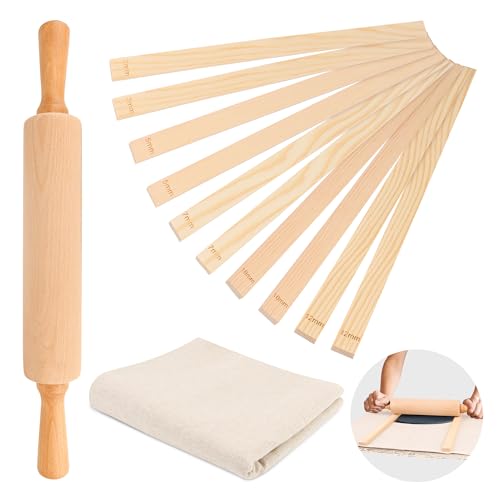
Not every potter needs a machine. This set takes the rolling pin route: a 17 inch wooden slab roller pin, ten wooden guide sticks in five sizes that set the slab thickness, and a linen tablecloth to roll on. The guides do the same job as a machine’s roller gap, resting the pin at a fixed height so the slab comes out even from end to end, with thickness options from about 0.12 to 0.47 inches.
It is the budget pick for beginners, students and anyone who hand-builds occasionally and cannot justify bench space for a press. The trade-offs are effort and width: you supply the pressure, wide slabs take several overlapping passes, and very soft clay can stick without the cloth kept clean and lightly dusted. As a first step into slab work, though, it teaches the fundamentals that carry over to any machine.
Specs
- Type: Rolling pin slab roller set with thickness guides
- Slab roller: 17 inch wooden rolling pin
- Guides: 10 wooden guide sticks in 5 sizes
- Thickness options: About 0.12, 0.2, 0.28, 0.39 and 0.47 inches
- Included: Linen tablecloth
- Material: Wood
- Tier: Budget
How to Choose
Start with working width, because it is the one spec you cannot change later. A 12 to 13 inch roller covers mugs, dinner plates, lidded boxes and runs of small tiles, which is most home handbuilding. If you make platters, large wall pieces or wide tile sheets, look at the largest table you have room for, and remember that the usable slab is always a little narrower than the roller itself.
Check the thickness system next. Crank presses adjust the roller gap, and a range up to about 30 mm, roughly 1.2 inches, covers everything from delicate sheets to thick bases. Shim and board systems, like the guide sticks in the AHIER set, are slower to change but very repeatable, because the thickness is set by a physical stick rather than a dial you can knock out of place.
Match the table to your clay. A rigid metal panel keeps thickness even across wide slabs; PVC and felt-covered surfaces are fine for small work but can flex under a heavy roll. Whatever the surface, clay should always be rolled between canvas or cloth so it releases cleanly and does not pick up the table texture unless you want it to.
Be honest about volume. A hand crank is plenty for a home studio and a classroom that rolls slabs a few times a week. If you are producing tile or dinnerware in quantity, none of these tabletop listings is the right tool; that is the point where the supplier-sold studio rollers from North Star, Brent or Shimpo, with 24 inch and wider beds, earn their keep.
Finally, plan the bench, not just the machine. Every crank roller needs a stable, clampable surface and room on both sides for the slab to enter and exit. Measure the footprint, including the swing of the handwheel, before you order.
Who Should Skip a Tabletop Slab Roller
Skip these machines if your slabs regularly exceed about 16 inches wide, if you throw on the wheel almost exclusively and rarely hand-build, or if you run a production studio, where a wide-bed studio roller with a wagon wheel drive will pay for itself in time saved. Printmakers should also note that the dual-purpose presses here are compromises for both crafts. And if you only make the occasional slab, the guided rolling pin set, or even guide sticks with a pin you already own, will do the job without another machine in the studio.
Frequently Asked Questions
What thickness can a tabletop slab roller make?
Most tabletop models adjust from paper thin up to about 30 mm, a little over an inch, which covers tiles, wall pieces, box walls and platter bases. Rolling in two or three passes, stepping the gap down each time, gives a more even slab than forcing the full reduction in one pass.
Can a printmaking press be used as a clay slab roller?
Yes, within limits. A press with a rigid plate and an adjustable roller gap will roll clay slabs evenly, which is why the Banfluxion and PreAsion presses appear in this guide. Keep the plate covered with canvas, clean clay off the roller before it dries, and accept that the working area is smaller than a dedicated studio roller.
Is a slab roller better than a rolling pin with guides?
For speed and repeatability, yes: one pass through a roller compresses the clay evenly, which helps slabs dry flat. A pin with guide sticks produces the same even thickness more slowly and is the better choice for beginners, small spaces and occasional work, which is why the AHIER set is included here.
What size slab roller do I need for tiles and plates?
A roller around 12 inches wide handles dinner plates, mug wraps and batches of 4 to 6 inch tiles. Tile makers should pay extra attention to thickness consistency, because a tile that varies across its width dries unevenly and warps in the kiln.
Final Verdict
For a dedicated clay machine that fits a home studio, the JIAYOFWCHI hand-cranked slab roller is the pick: pottery-first design, a useful working width and full published dimensions. Potters who roll slabs weekly should step up to the white Banfluxion for its rigid aluminum table and cast iron handwheel. The PVC Banfluxion and the PreAsion press cover small-format work for less, and the AHIER guided pin set is the right answer for beginners who want even slabs without buying a machine at all.