
Key takeaways
- Compare the best infrared thermometers for pottery, from a simple studio surface gun to a high-temperature pyrometer rated for raku and kiln-side checks.
- Top Pick: BTMETER BT-1500C Pyrometer Infrared Thermometer
- Runner-up: Fluke 62 MAX Plus Infrared Thermometer
- Also consider: Etekcity Lasergrip 1080 Infrared Thermometer
A kiln pyrometer reports the air temperature around its thermocouple, and that is only one of the temperatures a potter actually needs. An infrared thermometer answers a different set of questions: how hot the outside of the kiln runs near the lid and peepholes, how fast a raku piece is cooling after it comes out of the barrel, whether a shelf of ware is cool enough to unload, and whether one side of a kiln is running hotter than the other. It reads surfaces only, from a distance, in about half a second.
The five guns below are all the same product type, a handheld non-contact infrared thermometer, but they split into two camps. Four are general surface guns with top ends between 752 and 1,202 degrees Fahrenheit, suited to kiln exteriors, cooling ware, and studio checks. One is a high-temperature pyrometer-style gun rated to 2,732 degrees Fahrenheit, which is the only class of infrared tool that can follow ware at raku and stoneware temperatures. They differ in range, distance-to-spot ratio, and emissivity control, and those three specs decide which jobs each one can honestly do.
As an Amazon Associate, we earn from qualifying purchases.
Quick Answer
For surface checks around a working kiln, the BTMETER BT-1500C is the standout because its range reaches 2,732 degrees Fahrenheit, high enough for freshly pulled raku ware. The Fluke 62 MAX Plus is the rugged premium pick for kiln exteriors and cooling checks. The Etekcity Lasergrip 1080 and TempPro TP30 cover everyday studio work, and the Klein Tools IR1 is the simple budget option.
What an Infrared Gun Actually Measures
An infrared thermometer does not measure the temperature inside anything. It collects the infrared energy leaving a surface and converts that into a surface reading, which means two settings dominate its accuracy in a pottery studio. The first is emissivity, a measure of how efficiently a surface radiates heat. Matte bisque and rough kiln brick radiate well and read close to true. Glossy glaze radiates less and reflects some energy from its surroundings, so a gun with a fixed emissivity setting tends to read a glazed surface lower than it really is. An adjustable emissivity range, ideally 0.1 to 1.0, lets you compensate for that difference.
The second is the distance-to-spot ratio, written as D:S. A 12:1 gun aimed from twelve inches away averages everything inside a one-inch circle. Stand farther back and the circle grows, blending the peephole rim, the brick around it, and anything else in frame into one averaged number. High-ratio guns, 30:1 or 50:1, keep the measured spot small from a safe working distance, which matters when the target is a glowing piece of ware you should not approach closely. Keep both ideas in mind and the spec sheets below sort themselves quickly.
BTMETER BT-1500C Pyrometer Infrared Thermometer
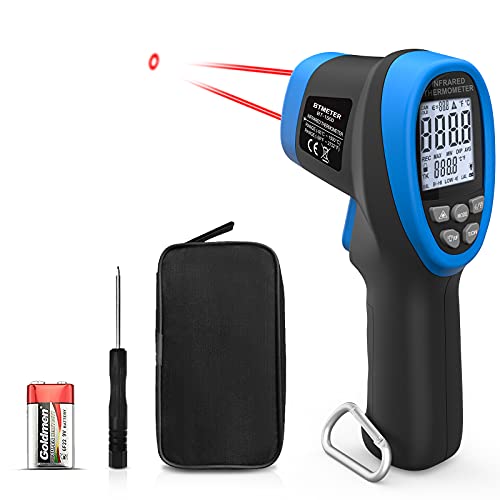
The BT-1500C is built for the temperature band potters actually fire in. Its range runs to 2,732 degrees Fahrenheit, so it can read a raku piece in the first seconds after the pull and follow it down through the cooling range where crackle patterns form, and it can take surface readings through an open peephole that would overwhelm a standard gun. The 30:1 distance-to-spot ratio keeps the target spot tight from a few feet away, and emissivity adjusts from 0.1 to 1.0 for switching between matte ware and glazed surfaces. A color display and a response time under 250 milliseconds suit quick repeated checks during a firing.
Specs:
– Temperature range: -58 to 2,732 degrees Fahrenheit (-50 to 1,500 degrees Celsius)
– Distance-to-spot ratio: 30:1
– Emissivity: adjustable, 0.1 to 1.0
– Response time: under 250 milliseconds
– Display: color LCD with laser targeting
– Power: 9V battery, protective zipper case included
Fluke 62 MAX Plus Infrared Thermometer

The 62 MAX Plus is the durability pick. It is rated IP54 against dust and water, drop tested to three meters, and built for exactly the kind of gritty, knock-prone environment a kiln room is. Its range tops out at 1,202 degrees Fahrenheit, which covers kiln exteriors, lids, and cooling ware rather than ware at firing temperature. Dual rotating lasers bracket the measured spot so you can see what the gun is averaging, emissivity adjusts across the full 0.10 to 1.00 range for glazed surfaces, and accuracy is listed at plus or minus 1 percent of reading or 1 degree Celsius, whichever is greater.
Specs:
– Temperature range: -22 to 1,202 degrees Fahrenheit (-30 to 650 degrees Celsius)
– Distance-to-spot ratio: 12:1, dual laser targeting
– Emissivity: adjustable, 0.10 to 1.00
– Accuracy: plus or minus 1 percent of reading or 1 degree Celsius
– Rating: IP54 dust and water resistance, 3-meter drop tested
– Power: single AA battery, about 8 hours with laser and backlight on
Etekcity Lasergrip 1080 Infrared Thermometer

The Lasergrip 1080 is the all-round studio gun. Its range reaches 1,130 degrees Fahrenheit, enough for kiln shells, element-adjacent surfaces once the kiln is open and cooling, and ware well into its cooling curve. Emissivity adjusts from 0.1 to 1.0, which the cheaper fixed-setting guns cannot do, and a maximum-reading display holds the highest value from a sweep across a kiln lid, a quick way to spot a hot patch that suggests an element or seal problem. The 12:1 ratio is ordinary, so it rewards working at moderate distances rather than across the room.
Specs:
– Temperature range: -58 to 1,130 degrees Fahrenheit (-50 to 610 degrees Celsius)
– Distance-to-spot ratio: 12:1
– Emissivity: adjustable, 0.1 to 1.0
– Display: backlit LCD with maximum temperature reading
– Response time: about 0.5 seconds
– Power: 2 AAA batteries, included
TempPro TP30 Infrared Thermometer Gun
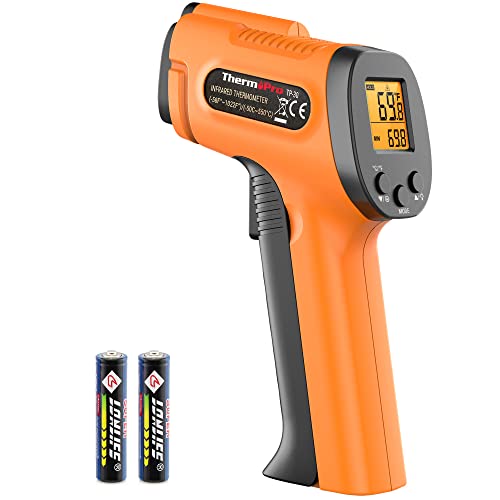
The TP30, sold under the TempPro name after earlier listings carried the ThermoPro brand, is a straightforward mid-range gun with the two features studio work needs most: adjustable emissivity and a maximum measurement mode. Its 1,022-degree Fahrenheit ceiling sits below the Fluke and Etekcity picks, but it still covers kiln exteriors, cooling ware, glaze room surfaces, and checks on molds and plaster. Accuracy is listed at plus or minus 1.5 percent, and the 500-millisecond response keeps up with sweeping a shelf of cooling pots. For a studio that wants one gun for general surface checks, it does the job without the trade-tool premium.
Specs:
– Temperature range: -58 to 1,022 degrees Fahrenheit (-50 to 550 degrees Celsius)
– Distance-to-spot ratio: 12:1
– Emissivity: adjustable
– Accuracy: plus or minus 1.5 percent
– Response time: 500 milliseconds
– Display: backlit LCD with maximum measurement mode
Klein Tools IR1 Infrared Thermometer
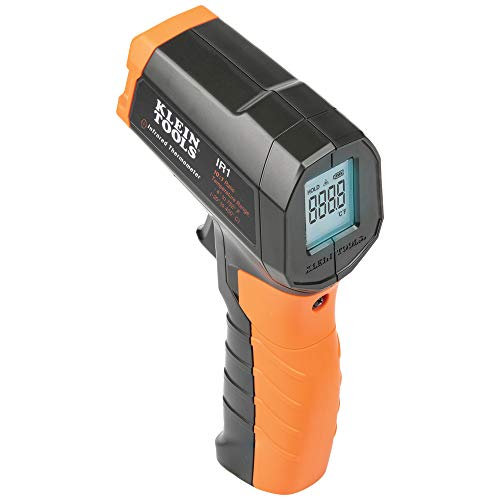
The IR1 is the simplest tool here and the easiest to live with. It gives up adjustable emissivity, fixing the setting at 0.95, which suits matte surfaces like bisque, brick, wood, and plaster but under-reads glossy glaze. Its range ends at 752 degrees Fahrenheit, so its pottery work is kiln exteriors, cooling ware near the end of the cycle, and general studio surfaces rather than anything mid-firing. In exchange you get a compact trade-brand gun with laser targeting, a backlit display, and an auto-hold that keeps the reading on screen after you release the trigger, useful when the angle makes the display hard to see while measuring.
Specs:
– Temperature range: -4 to 752 degrees Fahrenheit (-20 to 400 degrees Celsius)
– Distance-to-spot ratio: 10:1
– Emissivity: fixed at 0.95
– Targeting: single laser with auto-hold reading
– Display: backlit LCD
– Power: battery included
How to Choose
Match the range to the surface, not the firing schedule. Kiln exteriors, lids, and cooling ware live below 1,200 degrees Fahrenheit, and any gun here reads them. Ware at temperature is a different problem: only the BT-1500C reaches into the raku and stoneware band, and even it reads the surface of the piece, not the chamber.
Treat adjustable emissivity as close to mandatory. Glaze is the surface potters most often measure and the one fixed-setting guns read worst. If you plan to check glazed ware as it cools, choose a gun with an adjustable range and set it lower for glossy finishes, higher for matte bisque and brick.
Use the distance-to-spot ratio as a safety spec. A 30:1 gun reads a two-inch spot from five feet away. A 10:1 or 12:1 gun needs you much closer to keep the spot that small, and closer is the wrong direction around an open kiln or a raku barrel.
Decide which extras earn their place. Maximum-reading mode turns a sweep across a kiln lid into a hot-spot hunt. Dual lasers show the edges of the measured spot. High and low alarms, found on industrial models, can watch a cooling threshold so you are not standing over the gun. Plain data hold is enough for occasional checks.
Who Should Skip an Infrared Thermometer
Skip this entire product type if what you need is a firing temperature. No handheld infrared gun replaces a kiln pyrometer for following a schedule or confirming a cone bend, because it cannot see inside a closed kiln and reads surfaces rather than the chamber. Skip it, too, if your main target is shiny metal or wet, glossy glaze and you are unwilling to adjust emissivity or use a matte reference patch, since the readings will mislead you. And none of these tools is made for measuring people; they are surface instruments for objects only. If your real gap is knowing when a firing peaks, put the money toward a probe pyrometer instead and treat an infrared gun as a later companion.
Frequently Asked Questions
Can an infrared thermometer replace a kiln pyrometer?
No. A pyrometer follows the temperature inside the kiln through the whole firing, while an infrared gun reads a surface at one moment and cannot see through a closed lid. The two tools answer different questions, and studios that fire to a schedule still need the pyrometer as the primary instrument.
Why does an infrared gun read low on glazed pottery?
Glossy glaze has a lower emissivity than matte ceramic and reflects some infrared energy from the room instead of emitting its own. A gun set for a high-emissivity surface interprets that weaker signal as a lower temperature. Lowering the emissivity setting toward the value for glassy surfaces, or comparing against a matte patch on the same piece, closes most of the gap.
What distance-to-spot ratio do I need for kiln work?
For kiln exteriors and cooling shelves, 12:1 is workable because you can stand close safely. For ware that is still very hot, such as a raku piece just out of the barrel, 30:1 or higher keeps the measured spot small from several feet away, which keeps both the reading and the potter at a sensible distance.
Can these thermometers measure through a kiln peephole?
They can read the surface the laser lands on through an open peephole, but the spot has to fit inside the opening and the gun’s range has to cover firing temperatures, which limits the job to high-range models like the BT-1500C. The reading is the surface of the ware or cone pack in view, not the kiln’s internal air temperature.
Final Verdict
An infrared thermometer earns its place in a pottery studio as a surface tool, not a firing instrument. The BTMETER BT-1500C is the only pick here that follows ware into the raku and stoneware temperature band, and it is the right first choice for anyone who fires hot. The Fluke 62 MAX Plus is the better long-term tool for kiln exteriors and cooling checks in a rough workspace. The Etekcity Lasergrip 1080 and TempPro TP30 cover everyday studio surfaces at mid-range cost, and the Klein Tools IR1 suits simple checks on matte surfaces. Choose by the hottest surface you honestly need to read, and let emissivity control break any tie.









