Key takeaways
- Keep clay workable and greenware crack-free with the best humidifiers for pottery studios, from smart 6-liter tanks to a no-white-dust evaporative pick.
- Top Pick: LEVOIT Classic 300S Smart Humidifier (6L)
- Runner-up: Dreo HM713S Smart Humidifier (6L, Warm and Cool Mist)
- Also consider: LEVOIT Dual 200S Smart Humidifier (3L)
Every potter knows the sound of a dry studio, even if it never makes a noise. It is the rim of a bowl that has gone leather-hard while the foot is still soft, the handle that cracks where it joins the mug, the slab that warps because one face dried faster than the other. Heating and air conditioning pull moisture out of indoor air for months at a time, and clay gives up its water to that dry air unevenly. Plastic sheeting and damp boxes protect individual pieces, but they do nothing for the room itself.
A humidifier works at the level of the room. Holding the air at a steadier humidity stretches the working window for thrown and hand-built pieces, slows ware waiting for trimming, and keeps stored clay closer to the moisture level it had when it was wedged. The five models below cover the main ways to do that job, from a smart 6-liter tank that can run a whole studio to a compact unit that only has to look after one workbench.
As an Amazon Associate, we earn from qualifying purchases.
Quick Answer
For most studios, the LEVOIT Classic 300S is the easiest humidifier to live with: its sensor-driven Auto Mode holds a set humidity while a 6-liter tank runs for days. The Dreo HM713S adds warm mist for fast recovery in big rooms, the Honeywell HCM350 avoids white dust entirely, and the AquaOasis AO-101 covers one workbench on a budget.
Why Dry Air Works Against Clay
Clay dries by evaporation, and evaporation is a negotiation between the water in the piece and the water already in the air. When the room air is dry, exposed surfaces give up moisture quickly while thicker areas lag behind, and that gradient pulls rims out of round and opens cracks at joins. Plastic, spray bottles, and careful timing fight this one pot at a time; room humidity changes the background rate for everything at once. Air held in the middle range, roughly 45 to 60 percent relative humidity, slows surface drying enough that a thrown cylinder can wait for its base to catch up, and greenware can sit through a weekend without turning bone dry and fragile.
There is a ceiling worth respecting. Air kept very humid for long stretches encourages mold on ware boards, canvas, and wooden tools, and can rust steel ribs and banding wheel parts. The goal is a steady, moderate humidity, which is why models with a built-in humidity sensor and an automatic mode are so useful: they stop adding moisture once the target is reached instead of running until the tank is empty.
The White Dust Trade-Off Every Potter Should Know
Four of the five picks below are ultrasonic humidifiers. They use a vibrating diaphragm to throw a fine cool mist into the air, and they are quiet, efficient, and easy to control. They have one quirk that matters more in a studio than in a bedroom: ultrasonic units put everything dissolved in the tank water into the air, including minerals. With hard tap water, those minerals settle out as a pale dust on shelves, tools, and, most annoyingly, on drying greenware and bisque.
There are three ways around it. The simplest is filling the tank with distilled or demineralized water, at the cost of hauling water to the studio. The second is a demineralization cartridge where the model supports one. The third is an evaporative humidifier: a wick pulls water up from the tank and a fan blows air through it, so the water leaves as vapor and the minerals stay behind in the wick. The Honeywell pick below works that way, and for potters who worry about surface contamination, it is the conservative choice.
The Five Picks
LEVOIT Classic 300S: The Set-and-Forget Studio Default
The Classic 300S is built around a simple idea that suits studio life: set a target humidity and let the machine hold it. Its built-in sensor reads the room and the Auto Mode adjusts mist output to match, so the air stays in the band where clay dries evenly instead of swinging between damp mornings and parched afternoons. The 6-liter top-fill tank runs for days between refills on lower settings, and refilling means pouring water in from the top rather than carrying a dripping tank to a sink. Output is rated up to 300 milliliters per hour, enough for rooms up to about 505 square feet, which covers most home studios and small teaching spaces.
Specs:
– Tank capacity: 6 liters, top fill
– Type: Ultrasonic cool mist
– Mist output: Up to 300 ml per hour
– Coverage: Up to roughly 505 square feet
– Runtime: Up to 60 hours per fill on low
– Controls: VeSync app, voice assistants, built-in humidity sensor with Auto Mode
Dreo HM713S: Warm and Cool Mist for Bigger Rooms
The HM713S is the heavy lifter of this group. It offers both cool mist and a warm mist mode that Dreo rates at up to 500 milliliters per hour, which recovers humidity quickly after a kiln firing has dried the room out. The 6-liter tank supports runtimes of up to 60 hours, and a 12-hour timer plus app control with a humidity sensor make it easy to run hard during working hours and idle overnight. Warm mist does cost more energy than cool mist, so it works best as a recovery tool rather than a default setting.
Specs:
– Tank capacity: 6 liters, top fill
– Type: Ultrasonic warm and cool mist
– Mist output: Up to 500 ml per hour on warm mist
– Runtime: Up to 60 hours per fill
– Timer: Up to 12 hours
– Controls: App, voice assistants, humidity sensor with indicator light
LEVOIT Dual 200S: The Mid-Size Pick for One Work Area
Not every studio needs whole-room coverage. The Dual 200S carries a 3-liter top-fill tank and a built-in humidistat, sized for a single work area: the wheel corner, the wedging table, and the shelf where pieces wait their turn. It runs up to 25 hours per fill, and Levoit rates its noise level at 26 decibels, quiet enough to disappear under normal studio sounds.
App scheduling and automatic humidity control carry over from its bigger sibling, so it can keep a clay storage corner stable overnight without running at full tilt. The smaller footprint is also easier to place, and the half-size tank is cheaper to feed with distilled water.
Specs:
– Tank capacity: 3 liters, top fill
– Type: Ultrasonic cool mist
– Runtime: Up to 25 hours per fill
– Coverage: Rooms up to roughly 290 square feet
– Noise: Rated at 26 dB
– Controls: App, voice assistants, built-in humidistat
AquaOasis AO-101: Small, Simple, and Filter-Free
The AO-101 is the budget end of this list and the simplest machine here: a 2.2-liter tank, a dial, and a nozzle that rotates 360 degrees so mist can be aimed along a shelf of drying pots rather than straight up. It runs for more than 26 hours on a fill, shuts itself off when the water runs out, and needs no filter changes or cartridges, so its running costs stay at zero beyond the water itself.
What it gives up is automation. There is no sensor and no target humidity, so output is whatever the dial says until the tank empties. In a small studio or clay storage closet that is often enough, especially with an inexpensive hygrometer on the wall.
Specs:
– Tank capacity: 2.2 liters
– Type: Ultrasonic cool mist
– Runtime: More than 26 hours per fill
– Nozzle: 360-degree rotating
– Filter: None required
– Safety: Automatic shut-off when empty
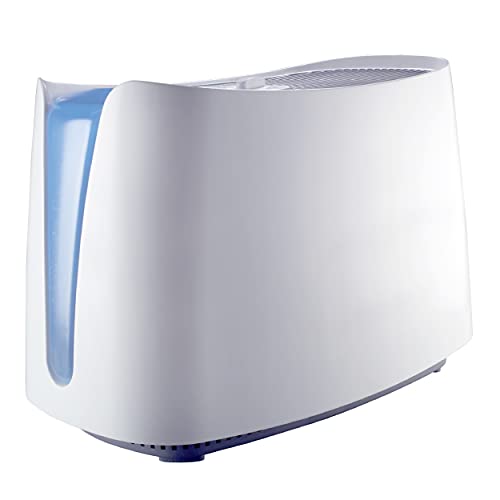
Honeywell HCM350: The Evaporative Pick That Skips White Dust
The HCM350 takes the other road. Instead of spraying mist, it draws water into a wicking filter and evaporates it with a fan, so minerals stay in the wick rather than settling on your pots. A UV stage treats the water on its way to the wick. The tank holds 1 gallon, output adjusts across three fan speeds, and a fill can run for up to 24 hours.
Evaporative designs are also self-limiting: as the room approaches saturation the wick gives up less water, so the unit cannot push a studio into swamp territory the way a neglected ultrasonic can. The costs are maintenance and noise: wicks need rinsing and periodic replacement, and a fan is never as silent as a diaphragm.
Specs:
– Tank capacity: 1 gallon (about 3.8 liters)
– Type: Evaporative cool moisture with wicking filter
– Water treatment: UV technology
– Output settings: 3 fan speeds
– Runtime: Up to 24 hours per fill
– Consumable: Replaceable wicking filter
How to Choose
Start with the size of the space you need to stabilize. A whole studio with wheels, shelving, and a kiln corner calls for a 6-liter model; a single bench does not, and oversizing mostly buys longer refill intervals rather than better results. Next, decide how you feel about white dust: if the unit will run on tap water near drying work, either budget for distilled water or put the evaporative Honeywell at the top of the list.
Then look at control. A built-in humidity sensor with an automatic mode separates a studio humidifier from a bedroom appliance, because the goal is a held target, not maximum output. Finally, plan on upkeep: every model here needs regular tank cleaning, since a humidifier that is never cleaned just distributes whatever grows in standing water.
Who Should Skip a Humidifier
Skip it if your studio already sits in a humid climate or a damp basement where the problem is too much moisture, not too little; a dehumidifier serves that room better. Skip it if you only work with small amounts of clay in short sessions, where plastic wrap and a damp box already cover the drying window. And skip the ultrasonic models if you will not clean tanks on a schedule, because a neglected tank is worse than dry air.
Frequently Asked Questions
What humidity level is best for a pottery studio?
A moderate band, roughly 45 to 60 percent relative humidity, suits most studios. It slows surface drying enough to even out leather-hard timing without encouraging mold on boards, canvas, and tools. Studios in very dry, heated spaces benefit most from holding the middle of that range consistently.
Will an ultrasonic humidifier leave dust on my pots?
It can, if the tank is filled with mineral-heavy tap water. The minerals in the water become airborne with the mist and settle as a fine pale dust. Using distilled water, a demineralization cartridge where supported, or an evaporative model like the Honeywell HCM350 avoids the problem.
Where should a humidifier sit in the studio?
Place it on a raised, stable surface with the mist aimed along shelving or across the room rather than directly at drying pieces, which can create wet spots and uneven drying in reverse. Keep it clear of the kiln’s heat and out of the splash zone around the wheel.
How often does a studio humidifier need cleaning?
Empty and rinse the tank every few days of use and give it a proper clean with a vinegar soak about once a week, following the maker’s instructions. Evaporative wicks need rinsing on the same rhythm and replacement when they stay stiff or discolored after cleaning.
Final Verdict
For most potters, the LEVOIT Classic 300S is the right answer: a big top-fill tank, honest coverage for a real studio, and an automatic mode that holds humidity where clay behaves best. Choose the Dreo HM713S when the room is large or needs fast recovery, the Dual 200S for one work corner, the AquaOasis AO-101 for simple bench-level help on a budget, and the Honeywell HCM350 when keeping mineral dust off your work matters most.