
Key takeaways
- Compare the best digital scales for pottery, from 5 kg bench scales for clay and reclaim to a 0.01 g pocket scale for glaze chemicals, oxides and stains.
- Top Pick: Escali Primo Digital Scale (P115)
- Runner-up: Jennings CJ-4000 Compact Digital Scale
- Also consider: Etekcity Food Kitchen Scale (EK6015)
Almost every recipe in a pottery studio is written in grams. A glaze formula is a list of weights, a clay body blend is a list of weights, and even reclaim gets more consistent when the additions are weighed instead of guessed. A digital scale turns those numbers from approximations into repeatable results, and the right scale depends on the job: portioning clay and mixing bucket-size glaze batches calls for capacity, while weighing colorants, oxides, and stains calls for fine readability.
This guide compares five digital scales that cover the weighing jobs a home or community studio actually does: four bench scales in the 4 to 5 kilogram range for clay, reclaim, and glaze mixing, and one pocket scale that reads to a hundredth of a gram. The picks are grouped into premium, mid-range, and budget tiers.
As an Amazon Associate, we earn from qualifying purchases.
Quick Answer
For most pottery studios, the Escali Primo is the digital scale to start with: a 5 kilogram bench scale with 1 gram readability, sealed buttons that shrug off clay dust, and a tare function that suits clay, reclaim, and glaze batches. Add the AMIR 500 gram pocket scale when you weigh oxides and stains to a hundredth of a gram.
How to Choose a Digital Scale for Pottery
Capacity comes first. Weighing clay portions, reclaim additions, and the base materials of a dipping glaze batch means the scale has to handle a mixing bucket plus several kilograms of dry material, so a 4 to 5 kilogram bench scale is the practical studio standard. A scale that tops out at 500 grams is still useful, but only as a second instrument for small additions.
Readability comes second, and it trades against capacity. One gram readability is plenty for clay, slip, and the main ingredients of a glaze, where a gram either way in a multi-kilogram batch changes nothing. Colorants are different: a stain or oxide added at a few grams per batch needs 0.1 gram readability at minimum, and 0.01 gram readability makes small trial batches far more accurate. Many studios end up with two scales, a bench scale for bulk work and a pocket scale for colorants, rather than one compromise instrument.
The tare function matters more in a studio than in a kitchen. Glaze mixing means weighing material after material into the same bucket, and tare resets the display to zero with the bucket in place so each addition is weighed on its own. A platform big enough for a bucket base and sealed or covered buttons also help, because clay dust and glaze splashes are hard on exposed controls. Grams are the studio standard unit, so a scale that defaults to grams is easier to live with than one that cycles through ounces first.
Escali Primo Digital Scale (P115)
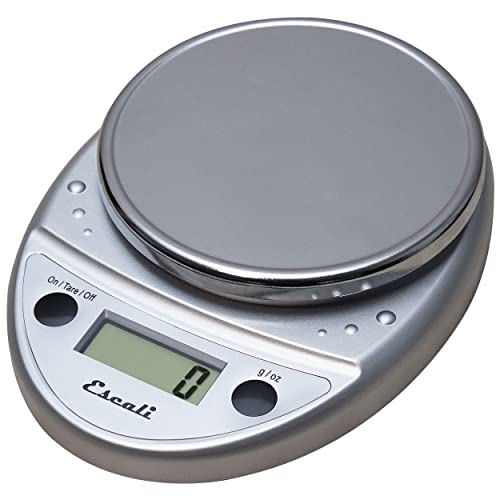
The Escali Primo is the bench scale most often recommended for studio weighing, and the reasons are practical. It reads up to 11 pounds, or 5,000 grams, in 1 gram increments, which covers a bucket of glaze base materials or a full reclaim mix without splitting the batch. The weighing platform measures 8.5 by 6 inches, large enough to seat a mixing bucket steadily, and the display stays visible behind the bucket rim.
The control buttons are sealed behind a smooth face, a small detail that matters in a pottery studio: clay dust, dry glaze powder, and splashes wipe off instead of working into the switches. The tare function zeroes the bucket so each material can be weighed in sequence. The Chrome version is listed under part number P115C, and other colors share the same platform and sensor.
This is the premium pick in the guide, for potters who weigh materials every session and want one scale that handles clay, reclaim, and glaze work.
Specs
- Brand: Escali
- Model: P115 (Chrome version part P115C)
- Capacity: 11 lb (5,000 g)
- Readability: 1 g (0.05 oz)
- Units: g, oz, lb:oz
- Size: 8.5 x 6 x 1.5 in
- Features: Tare function, sealed control buttons
- Best for: Everyday studio weighing, glaze batches, reclaim
Jennings CJ-4000 Compact Digital Scale

The Jennings CJ-4000 is a long-running favorite in coffee shops and studios, and its 4,000 gram capacity with 0.5 gram readability makes it a strong fit for pottery work. That half-gram step splits the difference between bulk weighing and precision work: fine enough for mid-size glaze test batches, with enough capacity for clay portions and reclaim.
A useful detail for studio use is the power setup. The CJ-4000 runs on AAA batteries or the included AC adapter, and the auto-off timing can be configured, so the display does not shut down in the middle of a slow, multi-ingredient glaze mix. It also has a piece-counting mode, handy for counting beads or test tiles, and a backlit display that stays readable in dim studio corners.
The Jennings sits in the mid-range tier: a step up in readability and power flexibility from the budget bench scales, in a compact body that stores easily on a crowded shelf.
Specs
- Brand: Jennings
- Model: CJ-4000 (SCCJ4000BK, Black)
- Capacity: 4,000 g
- Readability: 0.5 g
- Units: g, oz, lb
- Display: Backlit LCD
- Power: AAA batteries or included AC adapter, configurable auto-off
- Features: Tare function, piece-counting mode
- Best for: Glaze test batches, clay portions, reclaim
Etekcity Food Kitchen Scale (EK6015)

The Etekcity EK6015 is the budget bench pick, and for clay and glaze work its published specifications cover the essentials. It weighs up to 11 pounds, or 5 kilograms, in 1 gram increments, with a minimum measurement of about 3 grams. The platform is 304 stainless steel, which wipes clean of glaze splashes and does not hold stains from oxides the way a plastic platform can.
Five weighing units are included, including grams and milliliters, and the tare function handles sequential additions into one bucket. The backlit LCD is easy to read at an angle, and the slim body stores flat in a drawer. Two AAA batteries are included, so the scale is ready to use out of the box.
As a budget-tier pick, the EK6015 gives up the finer readability and sealed controls of the premium scales, but for weighing clay, slip, and full-size glaze batches it does the core job accurately and simply.
Specs
- Brand: Etekcity
- Model: EK6015
- Capacity: 11 lb (5 kg), minimum about 3 g
- Readability: 1 g
- Units: oz, lb:oz, fl oz, g, mL
- Platform: 304 stainless steel
- Display: Backlit LCD
- Power: 2 AAA batteries (included)
- Features: Tare function
- Best for: Clay, slip, and full glaze batches on a budget
EatSmart Precision Pro Digital Scale

The EatSmart Precision Pro is a straightforward mid-range bench scale with an extra-large LCD that suits potters who weigh at arm’s length across a wedging table. Capacity is 11 pounds, or 5 kilograms, with a graduation of 1 gram, and four weighing units: grams, ounces, pounds, and kilograms.
The two-button layout keeps operation simple: one button handles power and tare, the other switches units, so there is little to mis-press with dusty hands. The tare function zeroes a bucket for sequential glaze additions, and the 3 minute auto-off preserves battery life between batches. Two AAA batteries are included.
The Precision Pro does not offer the half-gram readability of the Jennings or the sealed buttons of the Escali, but it is a dependable general-purpose scale for clay portions, reclaim, and standard glaze mixing.
Specs
- Brand: EatSmart
- Model: Precision Pro (ESKS-01)
- Capacity: 11 lb (5 kg)
- Readability: 1 g (0.05 oz)
- Units: g, oz, lb, kg
- Display: Extra-large LCD
- Power: 2 AAA batteries (included)
- Features: Tare function, 3 minute auto-off
- Best for: General studio weighing, clay and glaze batches
AMIR Digital Pocket Scale, 500 g
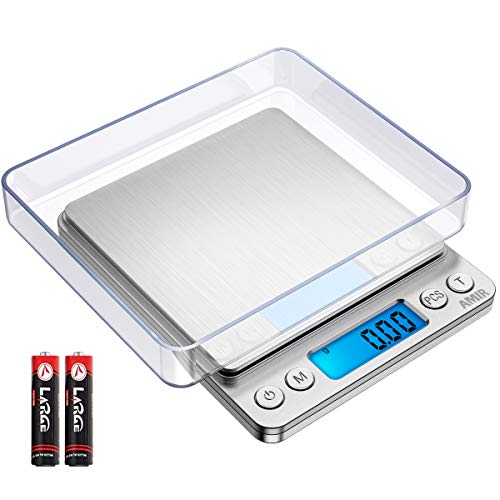
The AMIR pocket scale is the precision half of a two-scale studio setup. It weighs up to 500 grams with a readability of 0.01 grams, the level of accuracy colorant work demands: a test batch calling for 2 grams of stain or a fraction of a gram of cobalt oxide cannot be weighed honestly on a 1 gram bench scale.
The stainless steel platform is small, sized for a paper cup or a watch glass rather than a bucket, and two weighing trays are included for holding powders. Six weighing units, a tare function, a piece-counting mode, and a backlit display round out the feature set, and the pocket-size body stores in a drawer or travels to a workshop without fuss. Batteries are included.
This is a specialist in role: it does not replace a bench scale, and it should not be asked to. Paired with any of the bench scales above, it completes the weighing range a glaze-mixing studio needs.
Specs
- Brand: AMIR
- Model: 500 g Mini Pocket Scale
- Capacity: 500 g
- Readability: 0.01 g
- Units: 6 weighing units including g and oz
- Platform: Stainless steel, 2 weighing trays included
- Display: Backlit LCD
- Features: Tare function, piece-counting mode, auto-off
- Best for: Oxides, stains, colorants, and small test batches
Who Should Skip a Digital Scale
Potters who buy all of their clay and glaze ready-mixed, and who never adjust a recipe, can skip the precision end of this guide entirely; a basic bench scale will cover the occasional reclaim weighing. If your work is purely sculptural and you never mix materials by weight, a scale is a nice-to-have rather than a necessity.
Skip the pocket scale if you never weigh additions under about 20 grams, because a 1 gram bench scale already covers that range honestly. Skip the high-capacity bench scales if your work is limited to tiny test batches. And skip any scale without a tare function for glaze work, since sequential additions into one bucket are the main job these tools do.
Frequently Asked Questions
How accurate does a pottery scale need to be?
For clay, slip, and the base materials of a glaze, 1 gram readability on a 5 kilogram scale is accurate enough, because the amounts are large. For oxides, stains, and other colorants added in small quantities, look for 0.1 gram readability at minimum, and 0.01 gram readability for small test batches.
Can one scale handle both clay and glaze chemicals?
Only partly. A 5 kilogram bench scale with 1 gram readability handles clay, reclaim, and glaze base materials well, but it cannot weigh a 1 or 2 gram colorant addition accurately. Most glaze-mixing studios use two scales: a bench scale for bulk work and a 0.01 gram pocket scale for colorants.
Why does the tare function matter for glaze mixing?
Glaze recipes are weighed as sequential additions into a single bucket. Tare resets the display to zero with the bucket and each previous addition in place, so every material is weighed on its own without transferring or doing arithmetic between steps.
How do I keep a scale accurate in a dusty studio?
Keep the scale on a level, stable surface away from the wedging table’s vibration, wipe the platform after every session, and store pocket scales in their covers. Check the reading periodically with a calibration weight, and recalibrate following the maker’s instructions if the check weight reads off.
Final Verdict
For a single all-purpose studio scale, the Escali Primo is the pick to start with: 5 kilogram capacity, 1 gram readability, sealed buttons, and a platform sized for a glaze bucket. The Jennings CJ-4000 is the better choice when half-gram readability and AC power matter for long mixing sessions, while the Etekcity EK6015 and EatSmart Precision Pro cover the same bulk jobs in the budget and mid-range tiers. Add the AMIR pocket scale when your glaze work reaches colorants and test batches.









