
Key takeaways
- Compare the best glaze spray guns for pottery, from the Critter siphon gun to the Iwata Eclipse, with nozzle sizes, feed types, and air needs.
- Top Pick: Critter Spray Products 22032 118SG Siphon Gun
- Runner-up: Badger Air-Brush Co. 250-1 Basic Spray Gun Set
- Also consider: Paasche H-SET Single Action Airbrush Set
Dipping and pouring work well for single, even coats, but spraying opens up techniques those methods cannot match: layered colors that fade into each other, thin coats over textured surfaces, and even coverage on shapes that will not fit in a glaze bucket. The catch is that glaze is not paint. It is a suspension of ground minerals in water, heavier and more abrasive than most spray media, and it settles fast. A good glaze sprayer needs generous fluid passages, a container that is easy to stir and refill, and parts that strip down quickly for cleaning.
This guide compares five spray guns and airbrushes that potters actually use for glaze work, from a simple siphon gun built to move thick material to a fine dual-action airbrush suited to slips, engobes, and oxide washes. The picks are grouped by the job each one does best.
As an Amazon Associate, we earn from qualifying purchases.
Quick Answer
For all-over glaze coats, the Critter 118SG siphon gun is the easiest tool to live with because its open siphon design moves thick glaze without a fine needle to clog. The Badger 250-1 is the budget starter, the Paasche H-SET is the classic single-action airbrush for ceramics, the Paasche VL-3AS adds dual-action control, and the Iwata Eclipse HP-CS system is the premium pick for fine, layered detail work.
Critter Spray Products 22032 118SG Siphon Gun
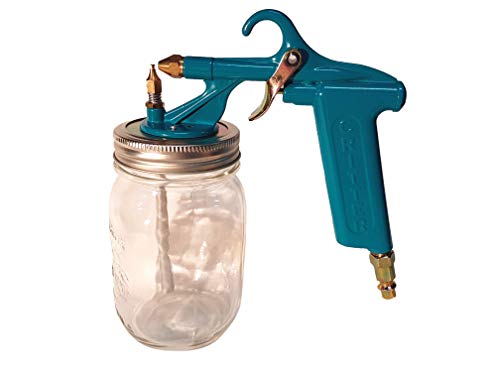
The Critter is the spray gun most often recommended in pottery studios, and its design explains why. Instead of a needle and fine nozzle, it uses a simple siphon tube that draws glaze up from a standard glass mason jar screwed onto the gun, so there is very little inside to clog, a real advantage with material full of ground rock and metal oxides. The round spray pattern adjusts in small steps, from a tight circle to a broad fan of roughly two and a half inches.
Because the jar is a plain canning jar, swapping colors means unscrewing one jar and fitting another. The trade-off is air demand: this is a real spray gun, not an airbrush, and the maker calls for a compressor of at least three-quarter horsepower delivering about three cubic feet of air per minute at ninety pounds per square inch, which rules out airbrush-only setups.
Specs
- Model: 22032 118SG Siphon Gun
- Feed type: Siphon feed from a 16 ounce glass mason jar
- Spray pattern: Adjustable round pattern, up to about 2.5 inches across
- Air supply: Compressor, about 3 CFM at 90 PSI, per the maker
- Construction: Metal gun body with replaceable jar gaskets
- Tier: Mid-range
Badger Air-Brush Co. 250-1 Basic Spray Gun Set

The Badger 250 is the simplest tool in this roundup, and it earns its place because the manufacturer specifically lists ceramic underglazing among its intended jobs. It is a single-action, external-mix spray gun: press the trigger and it sprays at whatever flow you have dialed in at the tip. Turning the tip adjusts the pattern from about three quarters of an inch to two inches.
The set runs at low pressure, between twenty and fifty pounds per square inch, so a small airbrush compressor or a propellant can with the included regulator can drive it. The attached jar holds only three quarters of an ounce, with a second jar in the box, so expect frequent refills on bigger work. Treat it as a starter gun for underglaze, slip, and thin glaze on modest pieces, not a production coating tool.
Specs
- Model: 250-1 Basic Spray Gun Set
- Action: Single action, external mix
- Feed type: Bottom feed jar, 0.75 ounce attached jar plus a spare jar
- Spray pattern: Adjustable from 0.75 inch to 2 inches
- Working pressure: 20 to 50 PSI
- Set includes: Spray gun, propel regulator, vinyl air hose, extra jar with cover
- Tier: Budget
Paasche H-SET Single Action Airbrush Set

The Paasche H is a pottery classroom staple; Paasche’s own catalog describes the H as its most popular airbrush for ceramic applications. It is a single-action, external-mix, siphon-feed airbrush with three interchangeable heads. The fine number one head suits detail and thin washes, the medium number three is the general-purpose choice, and the heavy number five, at just over a millimeter, is the one to reach for with glaze because it passes thicker material with fewer clogs.
Bottle assemblies screw on underneath, so you can keep several glazes ready and change over in seconds, and the external-mix design keeps glaze out of the airbrush body, making cleaning far quicker than with internal-mix brushes. Patterns run from about a sixteenth of an inch up to about an inch and a half, narrower than a true spray gun, so coating a large platter takes patience. For controlled, even coats on small and medium work, the H is hard to beat at its tier.
Specs
- Model: H-SET
- Action: Single action, external mix
- Feed type: Siphon feed bottle assemblies
- Head sizes: Number 1 at 0.45 mm, number 3 at 0.63 mm, number 5 at 1.07 mm
- Spray pattern: About 1/16 inch to 1.5 inches depending on head
- Set includes: Airbrush, three heads, 1 ounce bottle assembly, storage bottle, metal color cup, braided air hose
- Tier: Mid-range
Paasche VL-3AS Double Action Airbrush Set

The VL is the step up for potters who want to feather glaze rather than just lay it down. It is a double-action, internal-mix, siphon-feed airbrush: pressing the trigger controls air, pulling it back controls glaze flow, so you can start and end each pass softly and build gradients a single-action tool cannot match. A locking screw also lets you preset the needle and run it as a single-action brush for steady coats.
Like the H, the set includes three head sizes, and the largest, at just over a millimeter, is the practical choice for glaze. Internal mixing gives finer atomization, but glaze travels through the brush body, so it needs a thorough flush and needle wipe after every session. If your work involves layered color, stencils, or soft transitions, the VL-3AS is the most versatile tool in this group.
Specs
- Model: VL-3AS
- Action: Double action, convertible to preset single action
- Feed type: Siphon feed bottle assemblies
- Head sizes: Number 1 at 0.55 mm, number 3 at 0.74 mm, number 5 at 1.05 mm
- Spray pattern: About 1/32 inch to 1.5 inches depending on head
- Packings: PTFE needle packings
- Tier: Premium
Iwata Eclipse HP-CS Airbrushing System with Silver Jet Compressor

The Iwata Eclipse HP-CS sits at the precision end of this roundup. It is a dual-action, gravity-feed airbrush with a 0.35 millimeter nozzle and Iwata’s drop-in, self-centering nozzle design, which makes the nozzle easy to remove and clean. The funnel-shaped gravity cup holds about a third of an ounce, and this system listing pairs the airbrush with Iwata’s Silver Jet studio compressor, so it arrives ready to spray.
That small nozzle is both its strength and its limit. It produces the finest, most controlled spray here, suiting oxide washes, engobes, underglaze detail, and delicate layered effects over a base glaze. It is not the tool for pushing a thick, heavy dipping glaze; materials need to be well sieved and thinned, and even then the larger guns above coat a pot faster. Choose it when your spraying is closer to painting than to coating.
Specs
- Model: Eclipse HP-CS (ECL4500) system with Silver Jet compressor
- Action: Dual action, internal mix
- Feed type: Gravity feed, about 1/3 ounce funnel cup with lid
- Nozzle size: 0.35 mm, drop-in self-centering nozzle
- Optimal pressure: 25 to 35 PSI, per Iwata
- Includes: HP-CS airbrush and Silver Jet air compressor
- Tier: Premium
How to Choose a Glaze Spray Gun
Start with feed type. Siphon-feed tools with bottles or jars underneath are the natural fit for glaze: they hold more material, let you swap colors quickly, and keep the glaze where you can stir it. Gravity-feed airbrushes give finer control but hold only a small cup, suiting detail work rather than coating.
Nozzle size comes next, and it decides whether a tool clogs. For all-over coats, look for passages around a millimeter, or an open siphon design with no needle at all. Save nozzles of a third of a millimeter for sieved slips, engobes, and washes.
Match the spray pattern to your work. A gun throwing a two-inch or wider pattern coats mugs, bowls, and platters efficiently; narrower airbrush patterns give control for banding, stenciling, and gradients but make large pieces slow going.
Check your air supply before buying. True spray guns want a shop compressor with real airflow, measured in cubic feet per minute, while airbrushes run happily on a small studio compressor. Finally, plan for cleaning and wear: glaze is abrasive and needles and nozzles are consumables, so favor tools with available spare parts. Spray in a booth or ventilated space and wear a respirator rated for fine dust, since dry glaze overspray should not be breathed.
Who Should Skip a Glaze Spray Gun
Skip spraying if you only ever dip or pour single glazes; a spray setup adds a compressor, a booth, and a cleaning routine for benefits you may never use. Skip the fine airbrushes if your glazes are thick, gritty, or full of grog, because they will clog no matter how much you thin them. Skip the whole category if you have no way to control overspray, which settles on everything and contaminates other glazes. And if you glaze only a few small pieces at a time, a brush and a banding wheel will honestly do the job with far less setup.
Frequently Asked Questions
Do I need a compressor to spray glaze?
Yes. Every tool here runs on compressed air. Small airbrushes work with a compact studio compressor, while a true siphon spray gun like the Critter needs a shop compressor delivering roughly three cubic feet of air per minute. The Badger 250 can also run from a propellant can with its regulator, suiting occasional use.
How thin should glaze be for spraying?
Thinner than dipping consistency is the usual rule. Most potters spray glaze at roughly the consistency of thin cream, then adjust after a test tile. Sieve the glaze first, keep it stirred so the minerals stay suspended, and apply two or three light passes rather than one heavy coat, which can crawl or run as it dries.
Can I spray glaze with a regular hobby airbrush?
You can, with limits. A hobby airbrush will spray well-sieved, thinned glaze, slip, engobe, and oxide washes, especially with its largest needle and nozzle fitted. It will clog on thick or coarse glazes, and the abrasive minerals wear needles and nozzles faster than paint does, so treat those parts as consumables and clean the brush right after use.
How do I clean a spray gun after spraying glaze?
Flush it as soon as you finish, before the glaze dries inside. Spray clean water through the gun until it runs clear, then strip and rinse the jar, tube, needle, and nozzle. Dried glaze is far harder to shift and can ruin a fine nozzle, so a two-minute rinse after every session keeps these tools working.
Final Verdict
For most pottery studios, the Critter 118SG is the glaze sprayer to buy first: nothing else here moves thick glaze as reliably or cleans up as fast. The Badger 250-1 is the low-cost way to try spraying underglaze, the Paasche H-SET remains the classic single-action airbrush for ceramic work, and the VL-3AS adds the dual-action control that layered glazing rewards. The Iwata Eclipse HP-CS system is the specialist, worth its premium tier only if fine detail, washes, and gradients are central to your work.









