
Key takeaways
- Compare heat-resistant gloves for pottery kilns and raku: leather and foil-lined picks rated for brief contact with hot shelves, posts and ware.
- Top Pick: OZERO 16-Inch Cowhide Leather Welding Gloves
- Runner-up: RAPICCA Leather Fireplace Gloves, Dark-Grey 16 Inch
- Also consider: WZQH 16-Inch Leather Welding Gloves, Large
A good pair of heat-resistant gloves earns its place next to every pottery kiln. Potters reach for them when unloading a kiln that is still warm, lifting a hot shelf to check the ware below, pulling peep plugs, and moving pieces during a raku firing, where tongs and gloves work together and everything happens fast. The right pair protects hands and forearms during those short, deliberate contacts without turning simple tasks into clumsy ones.
The wrong pair is worse than none, because a glove that feels safe invites longer contact than any glove can handle. Every glove in this roundup is a long-cuff leather work glove with a published contact heat rating, an insulated lining, and stitching that holds up to repeated heat. They are tools for brief contact with hot surfaces, not a license to hold ware at firing temperature, and the picks below are grouped from certified heavy-duty protection down to a lighter mid-range option.
As an Amazon Associate, we earn from qualifying purchases.
Quick Answer
For most pottery kiln work, the OZERO 16-inch cowhide gloves are the strongest all-round pick, with certified heat protection and a foil-insulated lining. The RAPICCA 932-degree gloves suit heavier contact work, the WZQH pair adds Kevlar stitching, the grey RAPICCA covers lighter mid-range tasks, and the vclpower gloves fit larger hands.
The Best Heat-Resistant Gloves for Pottery Kilns
OZERO 16-Inch Cowhide Leather Welding Gloves

The OZERO gloves are the most completely specified pair in this group, and that documentation matters around a kiln. The listing carries EN388, EN407, and EN12477 Type A certification, which means the gloves have been measured against standardized tests for mechanical risks, thermal risks, and welding protection rather than relying on a marketing claim alone. For a potter, the EN407 rating is the relevant one, since it covers contact heat performance.
The construction suits kiln-side work well. The shell is cowhide split leather, the lining combines insulation with an air-isolated aluminum foil layer that reflects radiant heat, and the palm is reinforced where shelves and kiln furniture press hardest. At 16 inches, the cuff covers the forearm when reaching across a warm kiln shelf or into a raku kiln. The trade-off is dexterity: this is a structured glove, better for lifting and steadying than for delicate adjustments.
Specs:
- Length: 16 inches
- Outer: cowhide split leather
- Lining: insulated lining with air-isolated aluminum foil
- Heat rating: 932 degrees Fahrenheit
- Certifications listed: EN388, EN407, EN12477 Type A
- Palm: reinforced
RAPICCA Leather Fireplace Gloves, Dark-Grey 16 Inch

RAPICCA builds this glove in three layers: a fire-resistant cowhide leather exterior, an aluminum foil middle layer, and a heat-resistant cotton liner. The foil layer is the detail worth noting for kiln work, because much of the heat near an open kiln or a raku barrel is radiant, and a reflective layer slows how quickly that heat reaches the hand during short tasks like repositioning a shelf or steadying a hot lid.
The listing gives an unusually specific performance note, rating finger, palm, and back contact heat at 932 degrees Fahrenheit for 16 seconds, alongside an ANSI/ISEA heat level 4 classification. Sixteen seconds is a realistic working window for kiln tasks: long enough to lift, shift, and set down a hot piece of kiln furniture, short enough to enforce good habits. The dark-grey finish also hides the soot and kiln wash marks that light-colored gloves pick up in a single firing.
Specs:
- Length: 16 inches
- Outer: fire-resistant cowhide leather
- Middle layer: aluminum foil
- Liner: heat-resistant cotton
- Contact heat: 932 degrees Fahrenheit for 16 seconds, per the listing
- Heat classification: ANSI/ISEA heat level 4
WZQH 16-Inch Leather Welding Gloves, Large
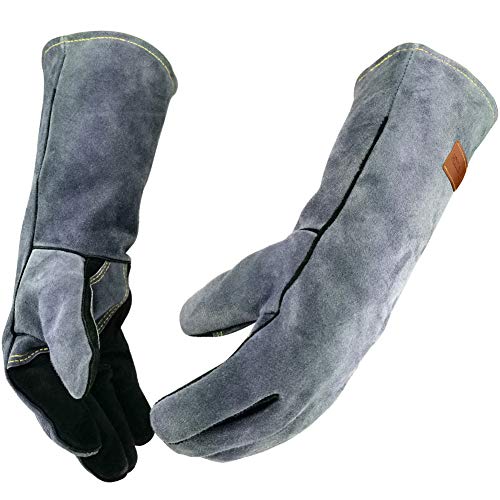
The WZQH gloves take a simpler, durability-first approach. The shell is 1.2 millimeter split shoulder cowhide, sewn with Kevlar thread, and Kevlar stitching is a genuine advantage around kilns because ordinary thread softens and fails long before the leather does. Seams are the usual failure point on heat gloves, so thread choice decides how many firings a pair survives.
The listing rates the gloves at CTC level 4 for contact heat, holding at 932 degrees Fahrenheit for more than 15 seconds, and assigns an ANSI/ISEA heat level 4 classification. It also names kiln work among the recommended uses, alongside forge, furnace, and fireplace tasks, which matches how potters actually use this style of glove. The cut is a classic welding gauntlet, roomy enough to pull on and shake off quickly, which matters when a raku piece needs attention right now.
Specs:
- Length: 16 inches
- Outer: 1.2 millimeter split shoulder cowhide leather
- Stitching: Kevlar thread
- Contact heat: CTC level 4, 932 degrees Fahrenheit above 15 seconds
- Heat classification: ANSI/ISEA heat level 4
- Fit: Large, gauntlet cuff
RAPICCA Fireplace Gloves, Grey 16 Inch

This grey RAPICCA model is the mid-range option in the lineup. Its structured product information lists a protective glove temperature rating of 662 degrees Fahrenheit, lower than the 932-degree pairs above, and that lower rating defines its role. It suits the long tail of warm rather than hot tasks: unloading a bisque kiln that has cooled partway, handling shelves during a slow unload, and working around a warm kiln exterior.
In exchange for the lower ceiling, a lighter-duty glove is typically easier to flex and less tiring across a long unloading session, and the 16-inch cuff still covers the forearm. It carries the same ANSI/ISEA heat level 4 classification as its heavier sibling. Studios that fire both low-fire and mid-fire schedules often keep a pair like this for routine unloads and reserve the heaviest gloves for raku days, which extends the life of both pairs.
Specs:
- Length: 16 inches
- Outer: leather
- Temperature rating: 662 degrees Fahrenheit, per the listing
- Heat classification: ANSI/ISEA heat level 4
- Size: X-Large
- Color: grey
vclpower Welding Gloves, 16 Inch, 2XL Red

Fit is a safety feature, and the vclpower gloves exist for potters whose hands swim in standard sizes or bind in them. This pair is cut in a 2XL size with a 16-inch cuff, built from double-layer cowhide leather with Kevlar stitching and a flame-resistant cotton insulation layer. A glove that fits properly keeps fingertips where they belong, which is where grip on a kiln shelf edge comes from.
The listing assigns an ANSI/ISEA heat level 3 classification, one step below the level 4 pairs in this roundup, with a stated heat resistance up to 932 degrees Fahrenheit. That combination places it sensibly: full-length, well-insulated protection for unloading and kiln furniture work, in a size range the other brands here largely skip. The red color is easy to spot in a busy studio, a small but real benefit when gloves get set down between tasks.
Specs:
- Length: 16 inches
- Outer: double-layer cowhide leather
- Stitching: Kevlar thread
- Insulation: flame-resistant cotton
- Heat resistance: up to 932 degrees Fahrenheit, per the listing
- Heat classification: ANSI/ISEA heat level 3
- Size: 2XL
How to Choose Heat-Resistant Gloves for a Pottery Kiln
Start with the contact heat rating, and read it correctly. A rating of 932 degrees Fahrenheit describes brief contact measured in seconds, not a working temperature. No glove in this class lets anyone hold ware at cone 06 or cone 6 temperatures; what the rating buys is time to lift a hot shelf, steady a kiln lid, or move a raku piece from kiln to reduction bucket without rushing. The seconds rating and the ANSI/ISEA or EN407 classification behind it matter more than the headline number.
Material decides how a glove ages. Leather tolerates abrasion from kiln shelves and brick, and it stays flexible after repeated heating. Foil layers reflect radiant heat, which dominates near an open kiln door. Kevlar stitching protects the seams, the first place cheaper gloves fail. Aramid knit gloves offer more dexterity for small work but give up the gauntlet cuff and the abrasion resistance that shelf handling demands.
Cuff length is the third factor. Kiln work involves reaching, and a 16-inch cuff keeps forearms clear of hot brick and element grooves when leaning into a top-loading kiln. Finally, fit and dryness: gloves should pull on fast, come off faster, and stay bone dry, because a damp glove conducts heat and can turn a warm shelf into a steam burn.
Who Should Skip These Gloves
Potters who always let an electric kiln cool completely before unloading, and who never handle ware or furniture while it holds any warmth, gain little from a 932-degree gauntlet; a basic pair of work gloves covers that routine. These long leather gloves are also the wrong tool for fine tasks such as wiring small ornaments or handling delicate unfired pieces, where any thick glove costs more control than it returns. And anyone expecting to grip ware directly at full firing temperature should skip gloves entirely and rethink the process, because tongs, kiln design, and patience are the correct tools at that heat.
Frequently Asked Questions
Can heat-resistant gloves handle pottery straight from a firing kiln?
No. These gloves are rated for brief contact with hot surfaces, measured in seconds, and pottery at peak firing temperature far exceeds what any glove can handle. Their role is unloading warm kilns, moving hot shelves and posts, and supporting raku work alongside tongs, where contact is short and deliberate.
What heat rating do I need for raku firing?
Raku involves fast moves between the kiln and the reduction bucket, with gloves steadying tongs, lids, and hot ware for a few seconds at a time. A long-cuff leather glove rated for contact heat at 932 degrees Fahrenheit, with an insulated or foil-lined construction, matches that work well. The 16-inch cuff matters as much as the rating, since forearms pass close to the kiln opening on every pull.
Are leather gloves or aramid knit gloves better for kiln work?
Leather gauntlets resist abrasion from shelves and brick, protect the forearm, and hold up to repeated heating, which makes them the better default for unloading and kiln furniture. Aramid knit gloves give finer finger control for small, warm items but usually stop at the wrist and wear faster against rough kiln furniture. Many studios keep both and choose per task.
How should leather kiln gloves be cared for?
Keep them dry, since moisture conducts heat and damages leather over time. Brush off kiln wash and soot after firing days, let the gloves air out fully before storing them, and keep them away from the kiln between uses so the lining does not bake. Inspect seams regularly, because stitching failure is the signal to retire a pair.
Final Verdict
For a single pair that covers the widest range of pottery kiln work, the OZERO 16-inch gloves lead this group on the strength of their certified EN407 rating, foil-insulated lining, and reinforced palm. The RAPICCA 932-degree gloves are the closest alternative, with a specific timed contact rating and a three-layer build. The WZQH pair earns its place through Kevlar stitching and an honest durability focus, the grey RAPICCA handles routine warm unloads as the mid-range pick, and the vclpower gloves solve the fit problem for larger hands. Match the glove to the hottest task in the studio week, keep contact brief, and any of these five will serve well.









