
Key takeaways
- Compare the best clay slab rolling guides and thickness strips, from guides-only wooden stick sets to full teaching kits with pins and cloths.
Uneven slabs are the quiet cause of most hand-building failures. A wall that is thick at one end and thin at the other dries at two speeds, and that mismatch is what warps tiles, opens seams on slab mugs and cracks box corners in the kiln. Rolling guides solve the problem mechanically: two sticks of identical thickness sit on either side of the clay, the rolling pin rides on the sticks instead of the clay, and the pin physically cannot press the slab any thinner than the sticks are tall. This guide compares five rolling guide and thickness strip sets, from guides-only wooden stick packs to full teaching kits, so you can pick the setup that matches how you already work.
As an Amazon Associate, we earn from qualifying purchases.
Quick Answer
The best clay slab rolling guides are paired wooden sticks in matched thicknesses that sit on both sides of the clay, so a rolling pin rides on them and stops at a set depth. The Sasylvia 10-piece set covers five thicknesses for most hand-building, while bundled sets from Newtay, AHIER and Baderke add a pin and work cloth.
How Rolling Guides Work
The technique is simple. Place two guide sticks of the same thickness on your work surface, one on each side of a flattened lump of clay, with a sheet of canvas or linen under the clay if you use one. Roll the pin across the clay in several directions, turning the slab between passes. At first the pin only touches clay. As the slab thins, the pin starts to rest on the sticks, and from that point every pass levels the surface instead of squeezing it thinner. The finished slab matches the stick thickness across its whole area.
Most sets sell sticks in pairs across five graduated thicknesses, roughly 3 mm to 12 mm, which covers the range hand builders actually use. Thin sticks suit ornaments, jewelry dishes and delicate box walls. Mid-range sticks around 6 to 7 mm are the everyday choice for mugs, plates and tiles. The thickest sticks suit platter bases and structural work that needs extra clay. Because the sticks are sold as matched pairs, you can also stack two sizes on each side to reach in-between thicknesses.
Guides differ from a slab roller machine in an important way: they cost very little, store in a drawer, and work anywhere, but they rely on your rolling technique for the final passes. They also differ from rolling pin guide rings, which only fit the pin they were sized for. Sticks work with any pin long enough to span them.
The 5 Best Clay Slab Rolling Guides and Thickness Strips
1. Sasylvia 10 Pcs Pottery Rolling Pin Guides (Wood Color)

This is the straightforward guides-only option for potters who already own a rolling pin they like. The set is ten wooden sticks in five thicknesses, two of each size, with a smooth sanded finish and no burrs. The sticks are long enough for most hand-building slabs and wide enough to stay put under the pin.
Specs:
- Contents: 10 wooden guide sticks (5 pairs)
- Thicknesses: approx. 0.12, 0.2, 0.28, 0.39 and 0.47 inch
- Stick size: approx. 13.4 x 0.8 inches
- Material: wood, natural finish
- Item weight: 8.8 ounces
- Model number: Sasylvia-Wooden Rolling Pin Guides-65
As a budget pick, it covers the full working range from thin ornament slabs to thick platter bases in one pack. The trade-off is that nothing else is included, so you supply your own pin and canvas. Wood also needs basic care: wipe the sticks clean after use and let them dry fully before storing, since bare wood can absorb moisture over time.
2. Wolwefa Clay Rolling Pin Guides, 10 Pcs Pottery Tools Set

The Wolwefa set is the other guides-only option, and it labels its sizes in metric, which suits potters who plan slabs in millimeters. Ten natural wood sticks give five paired thicknesses from 3 mm up to 12 mm, and the sticks run slightly longer than the Sasylvia set, which helps with wider slabs.
Specs:
- Contents: 10 wooden guide sticks (5 pairs)
- Thicknesses: 3, 5, 7, 10 and 12 mm
- Stick length: 13.5 inches
- Material: natural wood
- Rolling pin included: no
Because the sizes are printed around the familiar 3-5-7-10-12 mm ladder, stacking pairs to reach an in-between depth is easy to keep track of: a 5 mm pair plus a 3 mm pair gives roughly an 8 mm slab. Like the Sasylvia set, this is a budget, sticks-only purchase, best for potters adding thickness control to a bench that already has a good pin.
3. Newtay 12 Pcs Pottery Tools Set with Rolling Pin and Guides
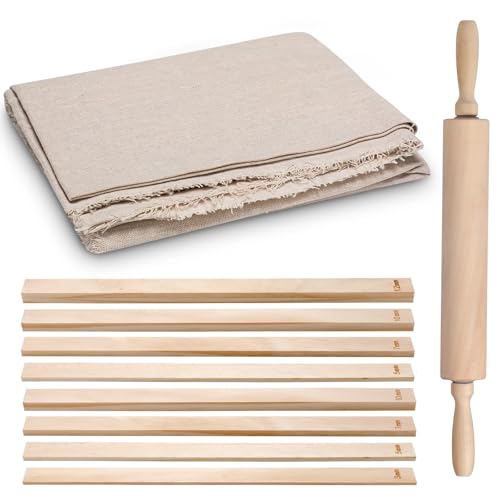
Newtay bundles the guides with the two things beginners usually lack: a wooden rolling pin sized for clay work and a linen tablecloth that doubles as a portable rolling and wedging surface. The ten guide sticks come in the same five graduated sizes as the guides-only sets, so the bundle loses nothing on thickness control.
Specs:
- Contents: 10 guide sticks, 1 wood rolling pin, 1 linen tablecloth
- Guide thicknesses: 5 graduated sizes
- Model number: JZ-Newtay-861
- Materials: wood guides and pin, linen cloth
This mid-range set is the sensible first purchase for a new hand builder, because the pin, guides and cloth are matched to each other and the cloth gives slabs a light canvas texture that releases cleanly. Potters who already own a favorite pin will pay for a duplicate, so it suits new setups and classroom benches better than established studios.
4. AHIER 12 Pcs Pottery Tools Set with 17-Inch Slab Roller
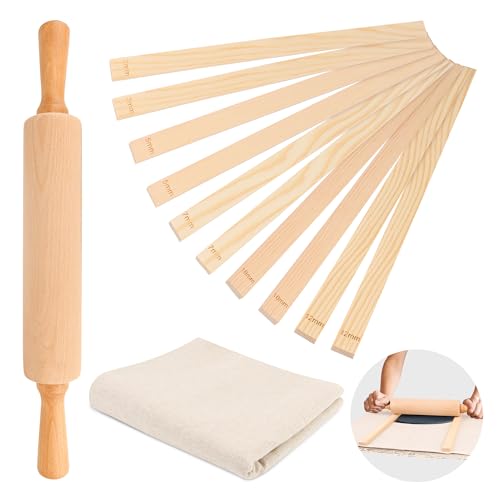
The AHIER set follows the same bundle logic but pairs the guides with a longer 17-inch rolling pin, which matters if you roll wider slabs for platters, large tiles or serving boards. The ten wooden guides cover five sizes, and a linen tablecloth is included for the work surface.
Specs:
- Contents: 17-inch rolling pin, 10 wooden guide sticks (5 sizes), 1 linen tablecloth
- Model number: pottery tools-12p
- Item weight: 2.48 pounds
- Materials: wood guides and pin, linen cloth
As a mid-range pick, it is the bundle to choose when slab width is the priority, since a longer pin bridges wider guide spacing without flexing in the middle. The longer pin is also the reason to skip it for small benches: it needs more clear space on both sides of the clay than a standard pin.
5. Baderke 20 Pcs Pottery Teaching Set

The Baderke set is the premium, classroom-oriented option. Alongside the ten guide sticks and a wooden rolling pin, it adds a large special linen cloth and eight clay sculpting tools, so one purchase covers rolling, surfacing and basic shaping for a teaching bench or a complete beginner setup.
Specs:
- Contents: 1 wooden rolling pin, 10 guide sticks, 8 clay sculpting tools, 1 linen cloth
- Rolling pin: about 15.35 inches long, 1.38 inches in diameter
- Linen cloth: about 59 x 39 inches
- Guide sticks: about 13.4 x 0.8 inches, in 0.12, 0.2, 0.28, 0.39 and 0.47 inch thicknesses
- Model number: LE2262
The generous cloth is the standout here: at roughly 59 by 39 inches it covers a whole worktable, which keeps clay off the surface and makes cleanup a matter of shaking out one cloth. The sculpting tools push this set beyond pure thickness control, so it makes the most sense for teachers, shared studios and gift purchases rather than potters who only need guide sticks.
How to Choose
Start with what you already own. If your bench already has a rolling pin and canvas you like, a guides-only set such as the Sasylvia or Wolwefa is all you need, and the only real decision is whether you think in inches or millimeters. If you are starting from nothing, a bundle with a matched pin and cloth, like the Newtay, AHIER or Baderke sets, removes the guesswork of pairing a pin length to your guide sticks.
Next, match guide length to your largest work. Sticks around 13.4 to 13.5 inches handle most mugs, tiles and small plates. Your pin must be longer than the gap between the sticks plus the slab width, so wide work points you toward the AHIER set and its 17-inch pin. Then check the thickness ladder: five sizes from about 3 mm to 12 mm cover nearly all hand-building, and paired sticks can be stacked for in-between depths.
Finally, think about care. All of these sets use bare or lightly finished wood, which is traditional for clay work because it releases well and does not chill the clay, but it should be wiped clean and dried after sessions rather than soaked. If your studio is shared or you teach, the Baderke set’s extra tools and full-table cloth earn their keep quickly.
Who Should Skip Rolling Guides
Skip guide sticks if you already own a slab roller machine and use it for every slab, since the machine sets thickness more repeatably for production runs. Skip them if your work is mostly wheel throwing, where bats and trimming tools matter more than slab thickness. Also skip the bundled sets if you already own a quality rolling pin and canvas; the guides-only sets give you the same thickness control without duplicate tools. And if you work almost entirely with polymer clay at jewelry scale, thinner acrylic depth guides made for that material will serve you better than full-size wooden sticks.
Frequently Asked Questions
What thickness should I roll slabs for mugs and tiles?
A mid-range stick around 0.28 inch, roughly 7 mm, is the common starting point for slab mugs and small tiles because it leaves enough clay for joining and carving while still drying evenly. Go thinner, around 0.2 inch, for lightweight ornaments and thicker, around 0.39 inch or more, for large tiles and platter bases that need to resist warping.
Can I use rolling guides with any rolling pin?
Yes, as long as the pin is long enough to rest on both guide sticks at once with the slab between them. A pin that is too short will dip between the sticks and defeat the purpose. Solid one-piece wooden pins are the usual match, and the pin should be straight and smooth so it rides evenly on the sticks.
How do I stop clay sticking to the guide sticks?
Work on canvas or linen, as the bundled sets provide, and keep the sticks clean and dry. A light dusting of cornstarch on very soft clay can help, but most sticking comes from clay that is too wet; letting the slab rest briefly between passes firms it up. Never soak wooden guides to clean them, since absorbed water can warp the wood and change the thickness.
Are rolling guides better than a slab roller?
They do the same job at very different scales. Guides are inexpensive, portable and accurate enough for one-off and small-batch hand-building, and they are how most hand builders learn slab work. A slab roller is faster and more repeatable for large volumes and very wide slabs. Many studios keep both, using guides at the bench and the roller for production days.
Final Verdict
For most hand builders, a guides-only set is the smart buy: the Sasylvia sticks cover five useful thicknesses and pair with the pin you already own, while the Wolwefa set is the pick if you plan work in millimeters. If you are equipping a bench from scratch, the Newtay bundle covers the basics, the AHIER set adds pin length for wider slabs, and the Baderke teaching set is the complete classroom option. Any of the five will give you flatter, more even slabs than rolling freehand.









