
Key takeaways
- Compare the best air purifiers for pottery studios, with True HEPA models sized by CADR for clay and glaze dust, from desktop units to large rooms.
- Top Pick: Winix 5500-2 Air Purifier (Premium)
- Runner-up: Medify MA-40 Air Purifier (Premium)
- Also consider: Levoit Core 300S-P Smart Air Purifier (Mid-Range)
Most of the dust in a pottery studio is invisible. Wedging, trimming dry greenware, sweeping, and mixing dry glaze all put fine clay particles into the air, and the smallest fraction stays airborne for hours after the work stops. Wet cleaning and a well-fitted respirator handle much of that exposure, but neither one scrubs the room itself. That is the gap an air purifier fills: it keeps pulling room air through a HEPA filter while you work and after you leave, steadily lowering the background dust load on shelves, lungs, and wet ware.
The five purifiers below were chosen for studio duty rather than bedroom duty. Each one uses a true HEPA or HEPA-grade filter stage, publishes a CADR rating or a verified room size so you can match it to your space, and uses sealed replacement filters that are easy to source. They are ordered from large-studio workhorses down to a compact unit for a small home studio corner.
As an Amazon Associate, we earn from qualifying purchases.
Quick Answer
For most pottery studios, the Winix 5500-2 is the strongest all-round pick, pairing True HEPA filtration with a washable carbon filter and AHAM-verified coverage for mid-size rooms. Small studios and glaze-mixing corners are better served by the compact Coway Airmega 50 or Levoit Core 300S-P, while the Medify MA-40 covers the largest spaces.
The Picks
1. Winix 5500-2 Air Purifier (Premium)

The 5500-2 is the unit that fits the classic one-room studio: strong enough for a few hundred square feet, with a four-stage filter stack that handles both fine particles and the solvent and kiln-room odors that drift through a working space. Its washable carbon filter is a genuine studio advantage, because glaze rooms go through carbon faster than living rooms do, and washing the AOC filter extends its working life between replacements. The PlasmaWave ionizer stage can be switched off, which matters for anyone who prefers purely mechanical filtration.
Specs:
– Model: Winix 5500-2
– Filtration: True HEPA, washable AOC carbon filter, PlasmaWave stage (switchable)
– AHAM verified room size: 360 sq ft
– CADR: 243 cfm dust, 246 cfm pollen, 232 cfm smoke
– Noise: from 27.8 dB on the lowest setting
– Certifications: AHAM, Energy Star, CARB, UL
2. Medify MA-40 Air Purifier (Premium)

The MA-40 is the pick for bigger teaching studios and shared workspaces, where one machine has to cycle a large volume of air. Its H13 True HEPA stage is rated by the manufacturer to capture particles down to 0.1 microns, which is the size range that matters for fine clay dust, and the three-stage stack puts a pre-filter in front of the HEPA element so coarse studio dust loads the cheap layer first. Touch controls, a child lock, and a timer round out a machine that is meant to be set up and left running through the workday.
Specs:
– Model: Medify MA-40
– Filtration: 3-stage pre-filter, H13 True HEPA, activated carbon
– Coverage: up to 1,793 sq ft in one hour (manufacturer rating)
– Particle capture: down to 0.1 microns (manufacturer rating)
– Controls: touch panel, timer, child lock
– Filter type: sealed replaceable cartridge
3. Levoit Core 300S-P Smart Air Purifier (Mid-Range)
The Core 300S-P suits a home studio that doubles as living space, because it adds scheduling to honest, verified performance numbers. Its CADR figures carry AHAM verification, and the VeSync app lets you run the purifier hard for an hour after a trimming session, then drop it to sleep mode before anyone has to share the room with it. The cylindrical 3-in-1 filter combines the pre-filter, H13 HEPA layer, and carbon layer in one cartridge, so a filter change takes minutes and exposes you to very little trapped dust.
Specs:
– Model: Levoit Core 300S (Core 300S-P)
– Filtration: 3-in-1 cartridge with H13 HEPA layer
– AHAM Verified CADR: 141 cfm smoke, 156 cfm dust, 175 cfm pollen
– Room fit: up to 219 sq ft at high air-change rates
– Dimensions: 8.66 x 8.66 x 14.17 inches
– Controls: VeSync app, Alexa voice control, sleep mode
4. Blueair Blue Pure 411i Max (Mid-Range)
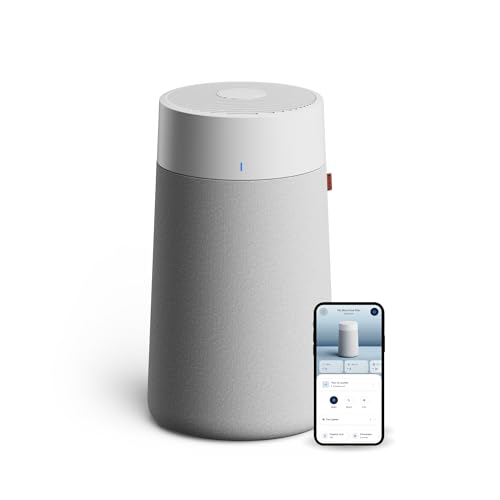
Blueair takes a different route to the same particle sizes with its HEPASilent system, which pairs electrostatic charging with mechanical filtration to move air more quietly than a conventional HEPA fan at the same output. In a studio where the purifier runs during classes or video calls, that low noise floor is the reason to pick it. A built-in particle sensor drives the auto mode, the washable fabric pre-filter catches the coarse dust that studios produce in quantity, and the whole unit is small enough to sit beside a wheel rather than in the middle of the room.
Specs:
– Model: Blue Pure 411i Max (BLU-411iMAX)
– Filtration: HEPASilent electrostatic and mechanical, washable pre-filter
– CADR: 141 cfm smoke, 163 cfm dust, 180 cfm pollen
– Room fit: cleans 219 sq ft in about 12.5 minutes on high
– Dimensions: 18.9 x 10.6 x 10.6 inches
– Controls: Wi-Fi app, PM2.5 sensor, auto and night modes
5. Coway Airmega 50 (Budget)

The Airmega 50 is a desktop-scale purifier for the smallest studios: a spare-room wheel setup, a glaze-mixing nook, or a single workbench where dry trimming happens. Its 360-degree intake pulls air from every side, which suits a unit that will live on a shelf or counter rather than in open floor space. An air quality indicator and auto mode mean it reacts on its own when a bag of dry glaze gets opened nearby, and at 14 watts it is cheap to leave running. Coway rates it for rooms up to 500 sq ft, though in dusty studio use it is best treated as a personal-zone machine for one work area.
Specs:
– Model: Coway Airmega 50 (AP-0425C)
– Filtration: 3-stage pre-filter, particulate HEPA filter, carbon filter
– Coverage: up to 500 sq ft (manufacturer rating)
– Noise: 18.4 dB in sleep mode
– Power draw: 14 watts
– Features: AQI monitor, auto and sleep modes, night light, filter indicator
How to Choose
Start with CADR, not with the coverage number printed largest on the box. CADR tells you how much clean air the machine actually delivers per minute, and for dusty work you want enough of it to cycle the room several times an hour. A simple sizing rule is to pick a smoke CADR of at least two-thirds of your room’s square footage, then go one size up if you mix dry glaze in the same space, because glaze days produce the heaviest dust load a studio sees.
Next, look at the filter stack. A washable or replaceable pre-filter matters more in a studio than in a home, because coarse clay dust will blind a HEPA element quickly if it reaches it directly. True HEPA and H13 or H14 HEPA grades all capture the fine fraction that stays airborne longest; the practical difference between them is smaller than the difference made by keeping the pre-filter clean. Carbon stages do nothing for clay dust itself, but they earn their place in studios that share air with kiln rooms or solvent storage.
Finally, think about running pattern. A purifier only helps while it runs, so noise and automation decide real-world performance: a quieter machine on a medium setting, or a smart model scheduled to run after sessions, will clean more air over a week than a loud machine that gets switched off. Place the unit near the dust source but clear of wet ware, and never treat it as a substitute for wet cleaning, which remains the primary dust control in any studio.
Who Should Skip These Purifiers
Skip this category entirely if your studio practice is fully wet: if you never trim dry, mix glazes from liquid, and wet-mop every surface, a purifier adds little beyond what your cleaning routine already does. Potters whose only dust exposure happens at the wheel during short sessions may also find that a respirator and a damp sponge cover their needs without another appliance to maintain.
Also skip the compact models if your studio is a large shared space. A desktop unit cannot cycle enough air to matter in a teaching studio, and buying two small machines usually costs more in filters than one properly sized unit. And if your main concern is kiln fumes rather than dust, a purifier is the wrong tool: fumes call for ventilation and a kiln vent, not recirculating filtration.
Frequently Asked Questions
Can an air purifier replace a respirator in the pottery studio?
No. A purifier lowers the background dust level in the room over time, but it cannot protect your breathing zone during the moment a dusty task creates a concentrated cloud. Keep using a properly fitted respirator for dry mixing, sweeping, and glaze work, and treat the purifier as a second layer that reduces overall exposure and keeps dust off finished work.
How often do studio purifier filters need changing?
More often than in a home. Studios load filters with fine mineral dust far faster than living rooms load them with pollen, so check the pre-filter monthly and expect the main HEPA cartridge to need replacement on the shorter end of the manufacturer’s stated interval. A machine whose airflow has visibly dropped is telling you the filter is loaded, whatever the indicator says.
Where should a purifier sit in a pottery studio?
Near the dust source but out of the splash zone: close to the trimming and mixing area, on the floor or a sturdy shelf, with its intake unobstructed. Keep it away from wet ware and glaze buckets so splashes cannot reach the filter, and avoid corners where air stagnates. One well-placed unit beats the same unit pushed behind storage boxes.
Does the carbon filter stage matter for clay dust?
Not for the dust itself. Carbon targets gases and odors, so it helps with kiln-room smells and solvent odors but does nothing for airborne clay particles. The HEPA stage does the dust work. Choose a model with carbon if your studio shares air with firing or finishing areas; otherwise a HEPA-only focus is fine.
Final Verdict
For a typical one-room studio, the Winix 5500-2 is the safest recommendation: verified CADR, a washable carbon stage, and enough output for a mid-size room. Larger shared studios should step up to the Medify MA-40, while small home studios are well served by the Levoit Core 300S-P or the quiet Blueair 411i Max. The Coway Airmega 50 earns its place as a personal-zone unit for a single bench or mixing corner. Whichever size you choose, pair it with wet cleaning and a respirator; the purifier is the layer that keeps working after you stop.









