
Key takeaways
- Compare the best spray bottles for pottery studios, from continuous misters to adjustable trigger sprayers, and keep clay evenly moist as you work.
- Top Pick: FLAIROSOL Original Continuous Mister
- Runner-up: BeautifyBeauties Continuous Spray Bottle
- Also consider: Bar5F M-Series Trigger Spray Bottles, 2-Pack
Clay dries from the surface inward, and it rarely dries evenly. The rim of a bowl firms up while the foot is still soft, one side of a slab stiffens faster than the other, and a coil pot left uncovered during a long join can crack where two stages of dryness meet. A spray bottle is the simplest tool for managing that moisture gradient. A few passes of fine mist rewet a surface without flooding it, soften a leather-hard edge before attaching a handle, and keep a work in progress pliable while you step away.
Not every spray bottle suits studio work, though. A coarse trigger sprayer can blast a wet spot into a soft wall, while a continuous mister lays down an even film of water that a sponge would disturb. This guide compares five spray bottles that cover the main studio jobs, from rewetting greenware to the heavier sprayers that earn their keep at the reclaim bucket and the cleaning sink.
As an Amazon Associate, we earn from qualifying purchases.
Quick Answer
For most potters, the FLAIROSOL Original continuous mister is the best spray bottle for pottery studio work: its 0.3 mm nozzle produces an ultra-fine, even mist that rewets greenware without pitting the surface. The BeautifyBeauties continuous bottle matches that misting style with a longer spray per pull, while the Bar5F, MR.SIGA, and FANSTINOW trigger sprayers suit heavier wetting, slip-adjacent cleanup, and multi-bottle studio setups.
Why Droplet Size Matters More Than Bottle Size
Two bottles with the same capacity can treat clay very differently, because the work is done by the droplets, not the reservoir. A continuous mister uses pre-compression technology: each trigger pull builds pressure that releases a sustained, aerosol-like cloud of very fine droplets. Those droplets land softly and spread into a thin, uniform film, which is what you want when evening out moisture on a leather-hard surface or softening a rim before burnishing. The surface drinks the water in gradually instead of taking a sudden soaking in one spot.
A standard trigger sprayer works differently. Each pull pushes a set volume through an adjustable nozzle, and the droplets are larger and arrive with more force. Dialled to a fine setting, it can mist a slab or dampen a canvas work surface. Dialled toward a stream, it becomes a utility tool for wetting down a wedging table, rinsing tools, or soaking a towel for a damp box. Neither style is better in the abstract; they are different instruments. Most working studios end up with one of each, which is why this roundup mixes both formats.
FLAIROSOL Original Continuous Mister
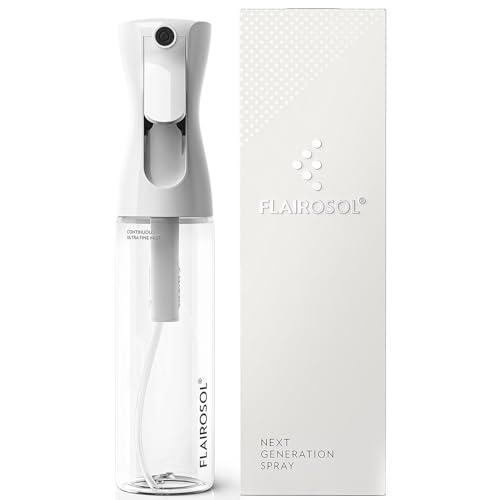
The FLAIROSOL is the bottle that defined the continuous-mist category, and it remains the reference point for fine water application at the pottery bench. Its 0.3 mm nozzle produces an ultra-fine mist that settles evenly, so a slow pass over a drying bowl adds moisture across the whole surface rather than in streaks. Because the spray is propellant-free and driven by pre-compression, the mist stays consistent down to the last of the water, and the bottle sprays at any angle, including upside down, which helps when misting the inside of a tall form.
The 300 ml capacity is a sensible middle ground for bench work: large enough for a full throwing session, light enough to hold in one hand while the other steadies the piece. The clear PET body with black print makes the water level obvious at a glance.
Specs:
– Capacity: 300 ml (10.1 oz)
– Material: PET plastic
– Nozzle: 0.3 mm ultra-fine mist
– Spray pattern: Continuous, about 1 second per trigger pull
– Spraying angle: 360-degree, works upside down
– Propellant-free pre-compression mechanism
BeautifyBeauties Continuous Spray Bottle

The BeautifyBeauties bottle uses the same continuous-mist principle with a slightly longer spray per pull, rated at 1.2 seconds with a fixed output of 1.25 cc per stroke. That longer, steady burst covers a wide slab or a platter in fewer passes, and the output stays fixed from the first drop to the last, so the tenth misting of the day behaves like the first. The bag-in-bottle design evacuates 98 percent of the liquid and supports spraying in every direction, which matters when you are reaching into a kiln-room shelf or misting the underside of a ware board.
Like the FLAIROSOL, it holds 10.1 ounces, and the clear body keeps the fill level visible. Potters who keep one bottle at the wheel and one at the hand-building table often pick this as the second mister, since the spray character is nearly identical and the hand feel is familiar.
Specs:
– Capacity: 10.1 oz (300 ml)
– Output: 1.25 cc per stroke, fixed from first to last drop
– Spray duration: 1.2 seconds per stroke
– Liquid evacuation: 98 percent, bag-in-bottle design
– Spraying angle: 360-degree
– Model: BBS5-2
Bar5F M-Series Trigger Spray Bottles, 2-Pack

Where the misters whisper, the Bar5F bottles do the heavier work. This two-pack of 16-ounce trigger sprayers adjusts from a fine mist to a direct stream, so one bottle can dampen a slab at its softest setting and then, opened up, wet down a plaster bat or rinse slip off tools at the sink. The listed output is 1.10 cc per pull, and the sprayer is built to be leak-proof, which counts when a bottle lives on its side in a tool bin.
The bottles are clear PET, BPA-free and food grade, so markings and water level are easy to read. One caution from the maker: the M-Series is not intended for oil-based liquids, and concentrated chemicals belong in HDPE bottles instead. For plain water, the studio liquid that matters, they are durable workhorses that nobody babies.
Specs:
– Capacity: 16 oz (500 ml) per bottle, 2-pack
– Material: PET (PETE1), BPA-free, food grade
– Output: 1.10 cc per pull
– Nozzle: Fully adjustable, fine mist to stream
– Leak-proof trigger sprayer
– Not intended for oil-based liquids
MR.SIGA Spray Bottles, 3-Pack

The MR.SIGA set is the multi-station option: three 16-ounce bottles with adjustable, leak-proof nozzles and measurement markings moulded along the body. The markings are the detail potters actually use, because studio liquids are often mixed to a ratio, from a small batch of vinegar water for joining to a diluted deflocculant solution. Filling to a printed line beats guessing, and three bottles mean one can live at the wheel, one at the glaze bench, and one at the sink without any of them travelling.
The nozzle adjusts from mist to stream, covering the same range as the Bar5F pair. If your studio discipline involves labelling a bottle for each job and leaving it there, a matched three-pack is the tidy way to do it.
Specs:
– Capacity: 16 oz per bottle, 3-pack
– Model: SJ21750
– Nozzle: Adjustable, leak-proof
– Measurement markings on the bottle body
– Mist to stream spray range
FANSTINOW Spray Bottles, 3-Pack

The FANSTINOW three-pack covers similar ground with a practical extra: the set includes a funnel and labels alongside the bottles. The funnel sounds minor until you are refilling at a studio sink with wet hands, and the labels solve the oldest studio problem, the mystery bottle whose contents nobody remembers. The 16-ounce PET bottles adjust between mist and stream settings, so they handle bench misting at the fine end and cleanup duty at the open end.
This is the most complete kit format in the group: bottles, filling aid, and identification in one box. For a teaching studio outfitting several workstations at once, or a home potter setting up dedicated bottles for water, slip spray, and glaze-area cleanup, it is the tidy way to do it.
Specs:
– Capacity: 16 oz per bottle, 3-pack
– Material: PET plastic
– Settings: Mist and stream
– Included: Funnel and labels
– Adjustable nozzle
How to Choose
Match the Sprayer to the Wetting Job
Start with the finest work you do. If you regularly rewet greenware, soften edges before joining, or mist pieces under plastic to slow drying, a continuous mister is the right primary bottle, because its fine droplets add water without disturbing the surface. If your spraying is mostly utility work, wetting towels, dampening canvas, rinsing tools, an adjustable trigger sprayer covers it and costs you nothing in delicacy you never use.
Consider Capacity Against Session Length
A 300 ml mister is a bench tool: light, precise, and refilled often. A 16-ounce trigger bottle holds close to half again as much and suits a full day at a shared station. Studios that spray constantly, such as classrooms, usually standardise on the larger format and keep one small mister per instructor.
Think About What Else Goes in the Bottle
Plain water is the default, but bottles also carry vinegar water, diluted solutions, and cleanup sprays. If you mix anything to a ratio, choose a bottle with measurement markings. If a bottle will hold anything beyond water and mild mixes, check the maker’s material guidance, since some PET sprayers are not rated for oils or concentrated chemicals.
Who Should Skip a Spray Bottle
Potters who work entirely in a humidity-controlled damp room, or who keep every piece under plastic from throwing to trimming, may find a mister redundant; a wet sponge and a covered ware board already do that job. If your only spraying need is glaze application, skip this category and look at glaze spray guns, which atomise glaze with compressed air rather than misting water. And if you need to move serious volumes of water, for reclaim soaking or floor washing, a bucket and a hose-end sprayer will serve you better than any hand bottle.
Frequently Asked Questions
Can I use a spray bottle on bone-dry clay?
You can mist bone-dry ware lightly, but do it gradually and evenly. Flooding one area of a bone-dry piece creates a steep moisture gradient, and the expanding wet patch can crack the surrounding dry clay. Several light, all-over mistings spaced a few minutes apart are far safer than one heavy soaking.
How often should I mist a piece while hand building?
Mist whenever the surface starts to look matte and feel resistant while the interior is still cool and damp to the touch. In a dry studio that may be every fifteen to twenty minutes of open working time. The goal is to keep the whole piece at one consistent stage of dryness, not to keep it wet.
What is the difference between a continuous mister and a trigger sprayer?
A continuous mister uses pre-compression to release a sustained burst of ultra-fine droplets from a single pull, laying down an even film of water. A trigger sprayer pushes a set volume per pull through an adjustable nozzle, producing larger droplets that can range from a mist to a direct stream. Misters suit surface care; trigger sprayers suit volume and utility work.
How do I stop a spray bottle nozzle from clogging in the studio?
Clay dust is the usual culprit, settling on the nozzle between sessions. Wipe the nozzle before the first spray of the day, store bottles away from dusty shelves, and run plain warm water through a sluggish sprayer before assuming it is broken. Straining reclaim water before it goes into any bottle also keeps grit out of the mechanism.
Final Verdict
The FLAIROSOL Original is the bottle to buy first: no other format here matches its fine, even mist for keeping greenware at a consistent moisture level. Add the BeautifyBeauties for a second mister with a longer spray per pull, and round out the studio with a trigger-sprayer pack, the Bar5F pair for adjustable heavy work, the MR.SIGA three-pack for measured mixes, or the FANSTINOW set for its funnel and labels. Moisture control is half of hand building and throwing alike, and it starts with the right bottle in reach.









