
Key takeaways
- Compare the best pottery sponges for wheel throwing, shaping and finishing, from absorbent throwing sponges to sponge sticks for tall clay pots.
- Top Pick: Mudtools Blue Workhorse MudSponge
- Runner-up: Mudtools Orange Most Absorbent MudSponge
- Also consider: Mudtools White Finishing MudSponge
A pottery sponge looks like the simplest tool in the studio, but it quietly controls two things that decide how a thrown piece turns out: how much water sits on the clay surface, and how clean that surface looks when the wheel stops. Too much water left standing in the base of a pot weakens the wall and invites cracks during drying, while a sponge with the wrong cell structure can drag grog across a smooth surface and leave it rough. Throwing sponges, finishing sponges, and sponge sticks all solve different parts of that problem.
This guide compares five pottery sponges that cover the full range of studio work. Three are shaped hand sponges from the Mudtools MudSponge line, each built around a different cell structure for throwing, absorbing, and finishing. The other two are sponge sticks from Xiem Tools and Kemper Tools, which put a sponge on a handle so you can clear water from the inside of tall, narrow forms without distorting the walls. Picks are grouped into premium, mid-range, and budget tiers based on build and role rather than price tags.
As an Amazon Associate, we earn from qualifying purchases.
Quick Answer
For most throwers, the Mudtools Blue Workhorse is the pottery sponge to start with: its open cells move water fast and the rib-like shape fits the hand. Add the Orange MudSponge for maximum absorbency, the White for finishing, and a sponge stick such as the Xiem X-Sponge II for tall, narrow pots.
Mudtools Blue Workhorse MudSponge

The Blue Workhorse is the all-purpose throwing sponge in the Mudtools line, and it earns the top spot here because it handles the widest range of wheel work. Its open-cell structure pulls water off the clay surface quickly during centering and pulling, and it wrings out cleanly so it does not dump water back onto the piece. The shape follows the curve of a traditional kidney rib, so it sits naturally against the palm and works like an extension of the hand when you are shaping a wall or cleaning the rim.
Like the other MudSponges, it is a compressed pop-up sponge that expands when it first gets wet, which makes it easy to store flat in a tool caddy. Mudtools rates this blue version as its general workhorse for everyday throwing and shaping, and the open cells tolerate groggy stoneware without tearing apart quickly. If you only buy one sponge from this list, this is the one that covers the most sessions.
Specs
- Brand: Mudtools (Sherrill Mudtools)
- Model: SM-MS-B-W
- Type: Hand throwing and shaping sponge
- Cell structure: Open cell, highly absorbent
- Form: Compressed pop-up sponge, expands in water
- Color: Blue
- Origin: Made in the USA
Mudtools Orange Most Absorbent MudSponge

The Orange MudSponge is the throwing specialist of the family. Mudtools describes it as its most absorbent sponge, and that single trait defines where it belongs in a studio: at the wheel, during long throwing sessions, when water management matters more than surface polish. The open, thirsty cell structure soaks up slip and standing water from the base of a pot faster than the blue version, which helps keep walls from going soft and slumping on taller cylinders.
Because it moves so much water, the Orange is less suited to final finishing passes, where a tighter cell leaves a smoother surface. Think of it as the sponge you reach for while the piece is still being formed, paired with a finer sponge for the last cleanup. It shares the same rib-inspired outline and pop-up format as the rest of the line, so it drops into an existing MudSponge routine without any adjustment.
Specs
- Brand: Mudtools (Sherrill Mudtools)
- Model: SM-MS-O-MO
- Type: Hand throwing sponge
- Cell structure: Open cell, most absorbent in the MudSponge line
- Form: Compressed pop-up sponge, expands in water
- Color: Orange
- Origin: Made in the USA
Mudtools White Finishing MudSponge

The White MudSponge is built for the opposite end of the process. Its tight-cell structure is deliberately less absorbent than the Blue Workhorse, which makes it a finishing sponge: it glides over leather-hard and freshly thrown surfaces, smoothing them without pulling grog particles out of the clay body or erasing fine detail. That suede-like pass is what cleans up rims, feet, and carved areas where a coarse sponge would leave the surface looking scratched.
At 3.75 by 2.63 inches it is a compact hand sponge, sized for control rather than bulk water removal. It also works off the wheel for wiping down greenware and cleaning up joins on hand-built pieces. On its own it cannot replace a throwing sponge, because it simply does not hold enough water, but as the second sponge in a two-sponge setup it is the budget-friendly piece that finishes the job the throwing sponges start.
Specs
- Brand: Mudtools (Sherrill Mudtools)
- Model: SM-MS-W-F
- Type: Hand finishing sponge
- Cell structure: Tight cell, less absorbent by design
- Dimensions: 3.75 x 2.63 inches
- Form: Compressed pop-up sponge, expands in water
- Color: White
Xiem Tools X-Sponge II Telescoping Sponge
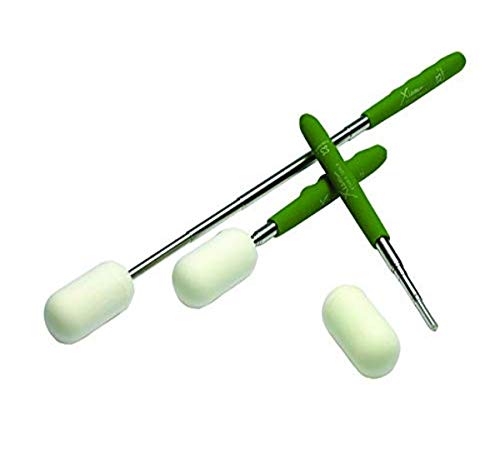
The X-Sponge II moves the sponge off your fingertips and onto a telescoping stainless steel handle with a rubber grip. The handle extends from 8.5 inches out to 23 inches, which changes what you can reach: the bottom of a tall vase, the inside of a narrow-necked bottle, or the far wall of a large bowl, all without pressing your knuckles against wet clay and warping the form. For potters who throw tall work, this reach is the entire point of the tool.
The dense white foam sponge head attaches with a threaded fitting, so a worn head can be unscrewed and replaced instead of discarding the whole tool. Replacement heads are sold under the same X-Sponge line. The fine-pored head behaves like a finishing sponge once it is inside the piece, soaking up pooled water and smoothing throwing lines in places a hand sponge simply cannot go. It is the premium pick here because the metal telescoping mechanism and replaceable head put it in a different class from a plain sponge.
Specs
- Brand: Xiem Tools
- Type: Telescoping sponge stick
- Handle: Stainless steel with rubber grip
- Length: Extends from 8.5 to 23 inches
- Sponge head: Dense white foam, threaded and replaceable
- Best for: Tall and narrow-necked thrown forms
Kemper Tools KMSPG Sponge Holder
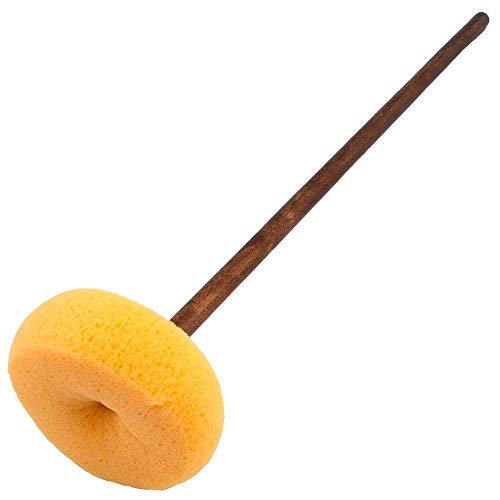
Kemper’s KMSPG takes the simpler, older approach to the same problem: a straight hardwood handle, 14 inches long, with the sponge clamped at the end by a screw and cup washer. The hardware sits protected so it does not gouge the inside of a pot while you work, and the rigid hardwood shaft will not bend or flex when you press the sponge into the base of a cylinder to lift out standing water.
The honest trade-off is the clamp itself. Because the sponge is held by hardware rather than molded onto the handle, it can work loose or spin if it is not seated firmly, and the screw fitting means swapping in your own favorite sponge takes a moment of fiddling. In exchange, the holder accepts almost any small sponge, not just a proprietary head, which makes long-term upkeep cheap and simple. It is the mid-range sponge stick for potters who want reach without a telescoping mechanism.
Specs
- Brand: Kemper Tools
- Model: KMSPG
- Type: Fixed-length sponge holder with sponge included
- Handle: Hardwood, 14 inches long
- Attachment: Screw and cup washer clamp, fits replacement sponges
- Weight: 1.6 ounces
- Best for: Mugs, cylinders, and medium-depth forms
How to Choose
Start with cell structure, because it decides what a sponge does to the clay surface. Open-cell sponges absorb the most water and are the right choice for throwing, centering, and cleaning slip off the wheel head. Tight-cell sponges absorb less and leave a smoother finish, so they belong in the last passes over a piece and on groggy clay bodies that mark easily. Most regular throwers end up owning one of each rather than forcing a single sponge to do both jobs.
Next, think about shape and size. Shaped hand sponges in the rib style give you a curved edge for shaping walls and a flat side for wiping, and they are the most versatile format for open forms like bowls and plates. Round or rectangular sponges suit flat cleanup work. If you throw tall or narrow forms, add a sponge stick to the kit: choose a fixed hardwood holder for medium-depth pieces, or a telescoping model when you need maximum reach and a replaceable head.
Finally, consider durability and upkeep. Compressed pop-up sponges ship flat and expand in water, and they last longer if they are rinsed free of slip and left to dry between sessions instead of sitting in the throwing bucket. Sponge heads on sticks are consumables, so check that replacements are easy to find before committing to a proprietary system. Buying one throwing sponge, one finishing sponge, and one stick covers nearly every situation a home or community studio produces.
Who Should Skip These Pottery Sponges
Skip the individual shaped sponges if you run a classroom or community studio that burns through sponges by the dozen; bulk synthetic tack sponges bought in multi-packs will serve that setting better, and the picks here are aimed at potters who keep a personal tool kit. Skip the sponge sticks if you only throw small, open forms such as plates and shallow bowls, because your hand and a regular sponge already reach everything on those pieces. And skip the tight-cell White MudSponge as your only sponge: it is a finishing tool that cannot move enough water for throwing, so it only makes sense as a companion to an absorbent sponge.
Frequently Asked Questions
What is the difference between a throwing sponge and a finishing sponge?
A throwing sponge has an open cell structure that absorbs a lot of water, which is what you need while centering and pulling walls. A finishing sponge has a tight cell structure that absorbs less water and glides over the surface, smoothing it without dragging grog or erasing detail.
How long does a pottery sponge last?
It depends on the clay body and how the sponge is stored. Abrasive, groggy clays wear sponges faster than smooth porcelain. Rinsing slip out after each session and letting the sponge dry between uses extends its life, while leaving it soaking in dirty bucket water shortens it.
Can a regular kitchen sponge replace a pottery sponge?
A kitchen sponge works in a pinch, but its cell structure and shape are designed for dishes, not clay. It tends to hold either too much or too little water, and the scouring side can scratch greenware. A shaped pottery sponge gives better control at the wheel and a cleaner finish.
Why would a potter need a sponge on a stick?
Standing water collects at the bottom of tall or narrow-necked pieces where fingers cannot reach without distorting the walls. A sponge stick lets you soak up that water and smooth the interior base of vases, bottles, and deep mugs while the piece stays true on the wheel.
Final Verdict
The Mudtools Blue Workhorse is the single best starting point for most potters: it throws, shapes, and cleans up competently in one tool. Pair it with the Orange MudSponge if your sessions involve a lot of water, and the White MudSponge when surface finish matters. If tall work is part of your practice, the Xiem X-Sponge II is the reach tool to own, with the Kemper KMSPG as the simpler fixed-length alternative. A small kit built from these five covers throwing, finishing, and deep-reach work without overlap.









