
Key takeaways
- Compare the best dust collectors for pottery studios by airflow, filtration, bag size, and mounting, with five single-stage picks for dry clay dust.
- Top Pick: WEN DC3474 Rolling Dust Collector
- Runner-up: POWERTEC DC5372 Portable Dust Collector
- Also consider: WEN DC1300 Dust Collector
Dry clay is the main dust problem in a pottery studio. Trimming leather-hard work, sanding bisque, mixing dry glaze, and sweeping up around the wheel all put fine clay particles into the air, and the finest fraction is the part a broom mostly pushes around. A respirator handles the dust that reaches your face, but source capture handles it earlier: a single-stage dust collector parked next to the sanding or trimming station pulls dusty air through a hose and traps it in a filter bag before it spreads across the room.
The five collectors below are bag-style, single-stage machines with 4-inch inlets, the size that matches standard dust hose. They range from a compact rolling unit for a one-wheel home studio to a larger dual-inlet model for a shared teaching space. All figures come from the makers’ published specifications. A collector does not replace wet cleanup, which stays the first line of defense against clay dust, but it cuts the airborne load during the dry jobs that wet methods cannot cover.
As an Amazon Associate, we earn from qualifying purchases.
Quick Answer
For most home pottery studios, the WEN DC3474 is the balanced pick: an induction motor, 600 CFM, and a 15-gallon bag in a unit that rolls or wall-mounts. The POWERTEC DC5372 has the finest bag filtration at 1 micron. The WEN DC1300 suits bigger shared studios, while the WEN DC3401 and BUCKTOOL DC30A-1 fit tight corners.
How to Choose
Airflow. Makers rate airflow in cubic feet per minute (CFM). A single sanding or trimming station is well served by the 550 to 660 CFM class. Studios that want one collector to cover two stations, or that run long hose lengths, should look at the 1,300 CFM class, because every bend and extra foot of hose reduces the pull at the tool.
Filtration. Dry clay and glaze dust are fine particles, so the bag rating matters more here than it does for coarse chips. A 1-micron or 2-micron bag holds back more of the fine fraction than a 5-micron bag. If most of your dry work is sanding bisque or mixing glaze, favor the finer bags in this list.
Bag capacity. Bag size sets how often you stop to empty it. Small 12-gallon bags suit occasional trimming in a home studio. Shared studios produce more dry waste and benefit from 15-gallon or 50-gallon bags. Bags with a viewing window and a bottom zipper are quicker to check and empty.
Mounting and footprint. Wall-mounted collectors keep the floor clear, which matters in small studios, but they fix the collector in one spot. Rolling models move to wherever the dry work happens. Several picks below do both, with casters for rolling and a bracket for wall mounting.
Motor type. Induction motors are the standard in this class and run cooler over long sessions. The one brushed-motor model below is lighter and simpler, aimed at shorter, occasional jobs. Noise varies by model, so place the collector as close to the dust source as the hose allows rather than compensating with a bigger motor.
The 5 Best Dust Collectors for Pottery Studios
1. WEN DC3474 Rolling Dust Collector

The DC3474 is the middle path in the WEN line and the easiest default for a home pottery studio. Its 7.4-amp induction motor is maker-rated at 600 CFM through a 9-inch impeller, enough pull for one sanding or trimming station on a short hose run. The 15-gallon bag is a step up from entry-level capacity, so it needs emptying less often during a run of trimming work.
Flexibility is the other draw. The unit rolls on swivel casters and has an onboard carrying handle, and it can also hang on the wall when floor space is tight. The zippered 5-micron bag is washable, which suits clay dust that cakes onto filter media.
Specs
- Motor: 7.4-amp induction
- Airflow: 600 CFM
- Impeller: 9-inch
- Inlet: one 4-inch port
- Bag: 15-gallon, 5-micron, zippered and washable
- Mounting: mobile base with swivel casters, optional wall mount
- Weight: 41.1 lb
2. POWERTEC DC5372 Portable Dust Collector

The DC5372 stands out for filtration. Its reusable bag is rated at 1 micron, the finest in this group, which makes it the natural pick for studios where the dry work is mostly fine dust: sanding bisque ware, trimming porcelain, or mixing dry glaze ingredients near the hose inlet.
The 1 HP induction motor is maker-rated at 560 CFM and runs on either 120V or 240V, handy in older buildings with limited circuits. The bag has a viewing window so you can see the fill level, and a bottom zipper for emptying. Casters make it a portable station unit rather than a fixed installation, and the 4-inch inlet takes standard dust hose.
Specs
- Motor: 1 HP induction, dual voltage 120V/240V
- Airflow: 560 CFM
- Filtration: 1-micron reusable bag
- Inlet: one 4-inch port
- Bag features: viewing window, bottom zipper
- Mounting: portable with casters
3. WEN DC1300 Dust Collector

The DC1300 is the step up for teaching studios and shared spaces. The 14-amp motor turns a 10-inch steel impeller at up to 3,450 RPM for a maker rating of 1,300 CFM, roughly double the compact models here. Two 4-inch inlets let it serve two stations at once, such as a trimming bench and a sanding box, without moving the machine.
The vertical collection bag holds up to 50 gallons, the largest capacity in this list, so a busy studio is not stopping mid-class to empty it. The trade-off is size: this is a floor-standing machine on a mobile base with four swivel casters, and it needs a permanent corner rather than a shelf or wall bracket.
Specs
- Motor: 14-amp
- Airflow: 1,300 CFM
- Impeller: 10-inch steel, up to 3,450 RPM
- Inlets: two 4-inch ports
- Bag: 50-gallon, 5-micron
- Mounting: mobile base with four swivel casters
4. WEN DC3401 Rolling Dust Collector
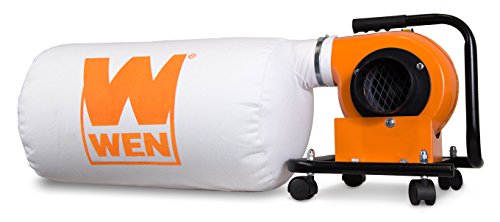
The DC3401 is the compact option for a one-wheel studio or a garage corner. At 17 lb with an onboard handle, it is light enough to carry to the work instead of plumbing the studio around it. The 5.7-amp brushed motor and 6-inch impeller are maker-rated at 660 CFM, which is strong airflow for its size and plenty for a single trimming or sanding station.
The 12-gallon zippered bag is the smallest here, so it fills faster than the bigger models, and the brushed motor suits shorter sessions rather than all-day running. Lockable swivel casters hold it in place while you work, and an optional wall mount gets it off the floor between sessions.
Specs
- Motor: 5.7-amp brushed
- Airflow: 660 CFM
- Impeller: 6-inch
- Inlet: one 4-inch port
- Bag: 12-gallon, zippered
- Dimensions: 34.25 x 13 x 14.2 inches
- Weight: 17 lb
- Mounting: lockable swivel casters, optional wall mount
5. BUCKTOOL DC30A-1 Wall-Mount Dust Collector

The DC30A-1 adds a remote control, which sounds minor until the collector is mounted high on a wall and the switch is out of reach. Its 1 HP totally enclosed, fan-cooled induction motor draws 6.5 amps and is maker-rated at 550 CFM through a balanced 9-inch steel impeller.
Filtration is a 2-micron bag, finer than the 5-micron bags on the larger WEN models, with a capacity of 13 gallons (3.1 cubic feet). The unit mounts on a wall bracket to save floor space, or rolls on its caster base when you want it beside a temporary sanding setup. The single 4-inch intake keeps the setup simple for one station.
Specs
- Motor: 1 HP, 6.5-amp, totally enclosed fan-cooled induction
- Airflow: 550 CFM
- Impeller: 9-inch balanced steel
- Filtration: 2-micron bag
- Bag capacity: 13 gallons (3.1 cubic feet)
- Inlet: one 4-inch port
- Extras: remote control
- Mounting: wall bracket or rolling caster base
Who Should Skip a Dust Collector
Skip a dust collector if your studio practice is fully wet: throwing, wet trimming, and damp cleanup only, with no dry sanding or dry mixing. In that case a collector has almost nothing to capture, and a respirator plus wet methods already cover the risk.
Skip one if what you actually want is cleaner room air overall. A dust collector captures dust at a hose inlet near one tool. Scrubbing the ambient air of a whole room is the job of a ceiling-mounted air filtration system, which is a different product. Also skip these single-stage bag models if you run a production studio with several wheels and a pugmill; that scale of dry waste points to a two-stage cyclone system with ducting, which sits above this class of machine.
Frequently Asked Questions
Can a woodworking dust collector handle clay dust?
Yes, for dry studio tasks. The machines here are sold for woodworking, but the capture principle is the same: dusty air is pulled through a hose and the particles are trapped in a filter bag. Clay dust is finer than most wood chips, so choose a model with a fine bag rating, and empty the bag outdoors while wearing a respirator.
What micron rating is best for clay dust?
Finer is better for dry clay and glaze dust. A 1-micron or 2-micron bag holds back more of the fine fraction than a 5-micron bag. If your dry work is mostly coarse trimming scraps, a 5-micron bag is workable; if you sand bisque or mix dry glaze, pick from the finer end of this list.
Where should a dust collector sit in a pottery studio?
As close to the dry work as the hose allows. Put it beside the sanding station, trimming bench, or glaze mixing spot, with the hose inlet near the point where dust is generated. Suction drops with hose length and bends, so a compact collector placed nearby often captures more than a larger one across the room.
Does a dust collector replace a respirator or wet cleanup?
No. Wet methods stay the primary control for clay dust, because they stop dust from becoming airborne at all, and a respirator protects you during dusty jobs like emptying the bag. A collector sits between the two: it reduces how much dry dust spreads through the studio during sanding, trimming, and mixing.
Final Verdict
For a single home studio, the WEN DC3474 covers the most ground: induction motor, 600 CFM, a 15-gallon bag, and the choice of rolling or wall mounting. If fine dust is your main concern, the POWERTEC DC5372 and its 1-micron bag are the better match. Shared studios should look at the WEN DC1300 for its dual inlets and 50-gallon bag, while the WEN DC3401 and the remote-controlled BUCKTOOL DC30A-1 suit small spaces where the collector has to stay compact or up on a wall.









