
Key takeaways
- Compare the best refractory cements for pottery kiln repair, from castable mixes to pre-mixed mortars, with temperature ratings, coverage and cure specs.
- Top Pick: Rutland Castable Refractory Cement, 25 lb
- Runner-up: Rutland Castable Refractory Cement, 25 lb
- Also consider: Mr Volcano Refractory Satanite, 10 lb
A pottery kiln rarely fails all at once. More often, a firebrick cracks along a joint, a corner crumbles where elements are pinned, or the fiber blanket in a raku kiln starts to flake and shed. Refractory cement is the material that handles those repairs: it bonds firebrick, patches spalled brick faces, casts replacement panels, and seals ceramic fiber so a kiln can go back into service without a full rebuild.
The right product depends on the job. Thick repairs and cast shapes call for a dry castable mix, thin joints are better served by a pre-mixed mortar, and fiber-lined kilns need a coating mortar rated well above the firing range. The five products below cover those three jobs, with published temperature ratings, coverage figures, and cure requirements for each one.
As an Amazon Associate, we earn from qualifying purchases.
Quick Answer
For most pottery kiln repairs, a castable dry mix such as the Rutland Castable Refractory Cement in the 25 lb tub is the practical default, since it patches cracked firebrick and casts replacement panels. Thin joints are easier with a pre-mixed mortar like Meeco’s Red Devil 610, while fiber-lined and raku kilns suit Mr Volcano Satanite, a coating mortar rated to 3200 degrees Fahrenheit.
How to Choose
Start with the repair type. Castable cements are dry powders mixed with water to a stiff, moldable consistency. They are the choice for rebuilding a broken brick section, casting a custom panel, or filling a hole deeper than about a quarter inch. Mortars, whether dry or pre-mixed, are thinner materials meant for joints and surface coats, and they will slump or crack if they are asked to hold a thick shape.
Next, match the temperature rating to the kiln. A cement’s published rating is its maximum service temperature, and it should sit comfortably above the hottest firing the repaired area will see. Low-fire, earthenware, and raku kilns work at ranges that most products here cover easily. A studio firing to mid-range or high-fire stoneware temperatures should check the rating carefully, because a cement rated at 2200 degrees Fahrenheit is a repair material for cooler zones and low-fire work, not for the hot face of a high-fire kiln.
Form matters for workflow. Pre-mixed cement is ready to trowel straight from the tub, which suits quick joint repairs and small patches, and the tub can be resealed between jobs. Dry mixes need measuring and mixing, and they have a limited pot time once wet, but they store well as powder and cost less material per repair on big jobs.
Finally, check the cure requirements before ordering. Some of these products air-cure completely with no heat cure at all, which is convenient for a kiln that cannot be fired until the repair is done. Others need a full day of drying before heat is applied, and rushing that step is the most common reason a patch fails early.
The 5 Best Refractory Cements for Pottery Kiln Repair
1. Rutland Castable Refractory Cement, 25 lb


The larger of Rutland’s two castable tubs is the workhorse pick for substantial repairs. It is a dry-mix cement that chemically sets and dries as hard as fire brick, so it can rebuild a damaged brick section or be cast into a mold to form a replacement panel for a kiln lid or wall. Rutland rates it to 2200 degrees Fahrenheit and publishes a compression strength of up to 3,000 pounds per square inch once fully cured, which is why it holds up in structural patches where a soft mortar would crumble.
Specs:
- Brand and model: Rutland Products, model 601
- Form: Dry mix, add water
- Temperature rating: Up to 2200 degrees Fahrenheit
- Mix ratio: 64 fl oz of water per 25 lb
- Coverage: 432 cubic inches per 25 lb container
- Compression strength: Up to 3,000 psi when cured
- Dry time: Minimum 24 hours; pot time 20 to 30 minutes
- Item weight: 25.25 lb
- Best for: Casting replacement panels and deep brick repairs in low-fire and raku kilns
2. Rutland Castable Refractory Cement, 12.5 lb
The 12.5 lb tub is the same castable formula in a smaller, budget-friendly size, suited to studios that only need one or two brick repairs rather than a full panel casting. It mixes at one quart of water per 12.5 lb and covers 216 cubic inches, enough for patching several cracked bricks or casting a single 12 by 12 by 1.5 inch square. Because the powder keeps in the sealed pail, it is a sensible size to keep on a studio shelf for occasional repairs.
Specs:
- Brand and model: Rutland Products, model 600
- Form: Dry mix, add water
- Temperature rating: Up to 2200 degrees Fahrenheit
- Mix ratio: 32 fl oz of water per 12.5 lb
- Coverage: 216 cubic inches per 12.5 lb container
- Item weight: 12.8 lb
- Package dimensions: 8.25 x 8.25 x 7.63 inches
- Best for: Small to medium brick patches and single cast pieces
3. Mr Volcano Refractory Satanite, 10 lb

Satanite fills a different niche from the castables. It is a refractory mortar powder designed to seal and protect ceramic fiber blanket, creating a smooth, durable hot face inside fiber-lined kilns, including the homemade raku kilns many potters build from a steel shell and blanket. Applied in thin coats over rigidized fiber, it keeps loose fibers out of the firing chamber and gives the lining a hard surface. Its 3200 degree Fahrenheit rating is the highest in this roundup, so temperature headroom is never the limiting factor.
Specs:
- Brand and model: Mr Volcano, model MVRC 10 Pounds
- Form: Dry mortar powder, mix with water
- Temperature rating: 3200 degrees Fahrenheit
- Application: Thin coats over ceramic fiber blanket lining
- Primary use: Sealing and coating fiber linings in kilns and forges
- Item weight: 10 lb
- Best for: Raku kilns and other fiber-lined kilns needing a protective hot-face coat
4. Meeco’s Red Devil 610 Refractory Cement, 0.5 Gallon

Meeco’s Red Devil 610 is the convenience pick: a pre-mixed, fiber-reinforced silicate mortar that is ready to trowel straight from the tub with no measuring or mixing. It is formulated for setting, bonding, and repairing firebrick and masonry joints, and the fiber reinforcement helps thin joints resist cracking as the kiln cycles. With a rating of up to 3000 degrees Fahrenheit, it covers the joint repairs on most studio kilns, and the resealable half-gallon tub suits the small, occasional jobs where mixing a batch of dry cement would waste material. Note that the manufacturer labels it for indoor use only.
Specs:
- Brand and model: Meeco’s Red Devil, model 610
- Form: Pre-mixed, ready to use
- Temperature rating: Up to 3000 degrees Fahrenheit
- Composition: Fiber-reinforced silicate mortar
- Container size: 0.5 gallon
- Primary use: Firebrick and masonry joints, setting and bonding brick
- Restriction: Indoor use only
- Best for: Quick joint repairs and small patches with no mixing
5. Girtech FireCast Castable Refractory Cement Mix, 20 lb
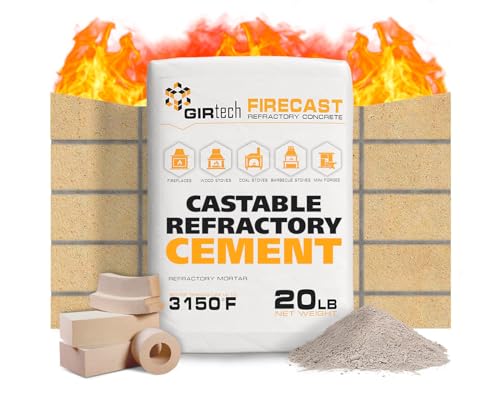
FireCast is the premium pick for potters who need a castable rated closer to high-fire work. Girtech rates the mix to 3110 degrees Fahrenheit, well above the Rutland castables, and it is sold as a build-and-repair material for kilns, ovens, and forges. The manufacturer’s instructions call for 3.4 to 3.8 fl oz of water per 2.2 lb of dry mix for casting, a fairly dry mix that holds a molded shape well. The 20 lb bag size suits a full lining repair or several cast panels in one session.
Specs:
- Brand: Girtech
- Form: Dry castable mix, add water
- Temperature rating: 3110 degrees Fahrenheit
- Mix ratio: 3.4 to 3.8 fl oz of water per 2.2 lb of mix for casting
- Primary use: Building, lining, and repairing kilns and ovens
- Container size: 20 lb
- Best for: Larger cast repairs where a higher temperature rating is required
Who Should Skip Refractory Cement
Skip these products if the damage is electrical rather than refractory. A kiln that fires unevenly because of a worn element, a failed relay, or a drifting thermocouple will not be fixed by any cement, and patching brick around a bad element only delays the real repair. Replacement elements and thermocouples are separate parts that should be matched to the kiln model.
Skip refractory cement as well if the kiln brick itself is soft, powdery, or crumbling across whole sections. Cement bonds to sound brick; it cannot restore strength to brick that has lost its structure, and widespread damage calls for replacement bricks or a furniture and brick rebuild instead. Finally, production studios firing daily to high-fire stoneware or porcelain ranges should skip the 2200 degree Fahrenheit castables for hot-face work and either choose the higher-rated products above or go to a kiln supplier for a rated repair material matched to their firing schedule.
Frequently Asked Questions
Can refractory cement repair a cracked kiln brick?
Yes, for cracks and spalls in otherwise sound brick. A castable cement can fill the crack and restore the surface, and a pre-mixed mortar handles hairline joints. If the brick is crumbling throughout or a whole section has broken away, casting a replacement piece or fitting a new brick is the more durable repair.
What temperature rating does a pottery kiln repair need?
The cement rating should exceed the hottest temperature the repaired area will reach. Low-fire and raku work stays within the range of every product here, while mid-range and high-fire kilns narrow the choice to the highest-rated options, such as the Satanite at 3200 degrees Fahrenheit and the FireCast at 3110 degrees Fahrenheit.
Does refractory cement need a heat cure?
It depends on the product. Rutland’s Dry Mix style mortars are documented as curing completely in air with no heat cure, while castable cements need at least 24 hours of drying before the kiln is fired. Always follow the cure schedule printed for the specific product, since heating a damp patch too soon can crack it.
Can refractory cement be used on ceramic fiber blanket?
Only the products formulated for it. A coating mortar such as Mr Volcano Satanite is made to seal ceramic fiber blanket and form a hard hot face. Thick castable cements are too heavy and rigid for blanket and should be kept to brick and cast work instead.
Final Verdict
For the typical studio repair, the Rutland Castable Refractory Cement in the 25 lb tub is the most versatile buy, with the 12.5 lb tub covering smaller jobs from the same proven formula. Keep Meeco’s Red Devil 610 on hand for fast joint work, choose Mr Volcano Satanite when the kiln is fiber-lined, and step up to Girtech FireCast when the repair needs the highest temperature rating a castable here can offer. Match the product to the repair type and the firing range, respect the cure time, and a patched kiln should return to regular service.









