
Key takeaways
- Compare the best pottery plaster for slip casting molds, master molds and reclaim slabs, with water ratios, working times and strength specs compared.
Pottery plaster is the absorbent gypsum that mold making runs on. Mixed with water and poured over a model, it sets into a porous block that pulls water out of liquid clay slip, which is how slip casting molds form a clay wall against their inner surface. The same material, poured flat, becomes the reclaim slabs and wedging boards that dry out recycled clay.
The five picks below split into two families. True pottery plasters are beta gypsum: soft, thirsty, and made for working molds. Gypsum cements such as Hydrocal and Ultracal 30 are alpha gypsum: much harder and far less absorbent, so they belong in master molds, case molds, and models rather than in the casting mold itself. The picks are grouped into budget, mid-range, and premium tiers.
As an Amazon Associate, we earn from qualifying purchases.
Quick Answer
For slip casting molds, USG No. 1 Pottery Plaster is the default choice, mixed at 70 parts water to 100 parts plaster by weight. Perfect Plaster is the mid-range alternative in a smaller bag. Hydrocal White and Ultracal 30 are gypsum cements for master and case molds, and the Falling in Art bag is the small trial size.
1. USG No. 1 Pottery Plaster, 10 Pounds (Mid-Range)
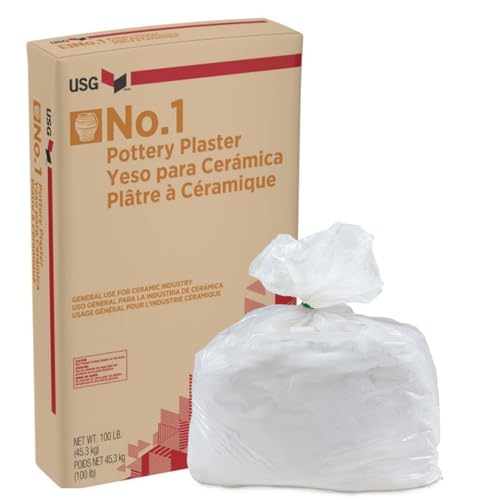
No. 1 Pottery Plaster is the industry standard for ceramic molds, the material USG describes as the best available for sanitaryware and dinnerware casting. It is formulated for controlled absorbency and long mold life, with reduced breakage compared with ordinary casting plasters, and the fine particle size reproduces detail cleanly from the model.
The working number is the consistency: 70 parts water to 100 parts plaster by weight. That ratio is not a suggestion to eyeball. Weighing both parts is what keeps one mold as absorbent as the next, and it is the ratio USG publishes for this product. A 50 pound bag yields about 1,150 cubic inches of set plaster, so this 10 pound bag covers a small one-piece mold, a set of sprig molds, or a modest reclaim slab. This listing is the repacked 10 pound size, sold with instructions included.
Specs:
– Type: beta gypsum pottery plaster
– Mix ratio: 70 parts water per 100 parts plaster, by weight
– Bag size: 10 pounds
– Best for: slip casting molds, press molds, reclaim slabs
– Model: No. 1 Pottery Plaster
2. Perfect Plaster for Pottery and Ceramic Casting, 8 Pounds (Mid-Range)

Perfect Plaster, from Perfect Craft, is blended for the pottery and craft market rather than the industrial mold shop. The maker positions it for slip casting molds, clay reclaim slabs, sculptures, and general mold making, and the powder is non-toxic and water-based, which suits school and community studios that need a simple safety profile.
It is a fast-curing formula, so working time is shorter than the USG standard: mix smaller batches, have the model and cottle boards ready before the water hits the powder, and pour promptly. The 8 pound bag is a practical middle size, big enough for a small casting mold or a pair of hump molds without committing to a full sack. Because it is a craft-market plaster, treat the first pour as a test: cast a small block, check how it drinks water from a slip sample, and adjust your casting times before pouring a mold you care about.
Specs:
– Type: pottery and ceramic casting plaster
– Bag size: 8 pounds
– Set behavior: fast-curing formula
– Safety profile: non-toxic, water-based powder
– Made in the USA
– Best for: slip casting molds, reclaim slabs, hump molds
3. USG Hydrocal White Gypsum Cement, 10 Pounds (Premium)
Hydrocal White is a gypsum cement, a different material from pottery plaster even though both start as gypsum rock. The alpha crystals grow denser, so the set block is much harder, stronger, and far less absorbent. USG describes it as a full-strength gypsum cement that is not cut with cheap fillers, designed for strength and casting detail in both hollow and solid casting.
That profile makes Hydrocal the pick for the steps around the working mold: master models, case molds that will mother a set of working molds, and solid castings that need a hard, chip-resistant surface. It accepts liquid and crystal pigments, so masters can be color-coded by set. It is quick setting, so batches should be sized to the pour. The listing ships in a resealable, water-tight bag rather than a carton, which matters because gypsum that has absorbed room humidity sets erratically. Do not substitute it for pottery plaster in a slip casting mold; the absorbency that makes casting work is exactly what this material gives up.
Specs:
– Type: alpha gypsum cement
– Bag size: 10 pounds, resealable water-tight bag
– Set behavior: quick setting
– Best for: master models, case molds, hollow and solid casting
– Model: USG_Hydrocal_10lbs
4. USG Ultracal 30 Gypsum Cement, 10 Pounds (Premium)

Ultracal 30 is the precision end of the gypsum cement family. USG rates it harder and stronger than the Hydrocal A-11 and B-11 cements, with the lowest expansion of any rapid-setting gypsum cement it makes: the published final expansion is about 0.08 percent, and typical dry compressive strength is about 6,500 psi. The mix ratio is 38 parts water per 100 parts plaster by weight, a much stiffer mix than pottery plaster, which is part of where the density comes from.
In a pottery studio, that accuracy is for duplicator work: case molds and splash-cast molds where a working mold has to come out the same size every time, and models that will be reproduced in resin or used as masters for a mold series. The Laguna listing here is the 10 pound bag, and the maker notes it takes excellent detail, including from latex molds. Like Hydrocal, it is the wrong material for the absorbent face of a slip casting mold; use it to build the masters that pottery plaster working molds are poured from.
Specs:
– Type: alpha gypsum cement, tooling grade
– Mix ratio: 38 parts water per 100 parts plaster, by weight
– Setting expansion: about 0.08 percent
– Dry compressive strength: about 6,500 psi
– Bag size: 10 pounds
– Model: Ultracal3010lbs
– Best for: case molds, duplicator models, splash casting
5. Falling in Art Plaster of Paris, 1 Pound (Budget)

The Falling in Art bag is plain plaster of Paris in a 1 pound size, the smallest commitment on this list. Plaster of Paris is the general-purpose beta gypsum: it sets fast, casts cleanly at small scale, and is softer and less uniform than a formulated pottery plaster, which is fine for sprig molds, small stamps, texture plates, and one-off craft molds.
The small bag is the point. It lets a beginner run a first mold without storing an open sack of powder, and it is the right size for classroom single-session projects and for testing a model before scaling up to a full pour. The brand lists it for hand mold casting kits, sculpture, dioramas, and pottery and ceramic plaster work. Expect to work quickly once it is mixed, and expect a working mold from it to live a shorter life than one poured from No. 1 Pottery Plaster; for a handful of casts, that trade is usually acceptable.
Specs:
– Type: plaster of Paris, beta gypsum powder
– Bag size: 1 pound
– Set behavior: fast setting
– Model: CT0021
– Best for: sprig molds, stamps, small test molds, classes
How to Choose
Start with the job, because the two families are not interchangeable. A slip casting mold must drink water evenly for its whole life, so it needs a beta pottery plaster mixed at its published consistency. A master or case mold must hold an edge and survive repeated pours, so it needs an alpha gypsum cement. Swapping them produces a casting mold that barely absorbs or a master that crumbles at the corners.
Second, respect the mix ratio. Consistency numbers are parts of water per 100 parts of plaster by weight: 70 for No. 1 Pottery Plaster, 38 for Ultracal 30. Adding extra water to make pouring easier weakens the set block and changes its absorbency, and adding extra powder to stiffen a mix shortens working time and traps air. Weigh both parts every time.
Third, size the bag to your pour rate and your storage. Gypsum absorbs humidity from the air and slowly loses its set quality, so a small bag used within a few sessions beats a large sack stored open in a damp studio. Keep bags sealed, off the floor, and away from wet work areas.
One supply note: in 2026 USG announced it would idle the Southard, Oklahoma plant behind much of its specialty gypsum line, and dealers report that No. 1 Pottery Plaster, Hydrocal, and Ultracal production is being phased out. Bagged stock remains on sale, but if your studio standardizes on one of these, confirm availability before planning a large mold series.
Who Should Skip Pottery Plaster
Skip plaster entirely if you buy ready-made molds and never pour your own; a bag of gypsum has a shelf life and will only take up dry storage. Skip it if the mold must flex, since plaster is rigid and undercuts lock in; flexible molds call for silicone rubber instead. Skip the gypsum cements if your only goal is slip casting, because their low absorbency works against the casting process. And skip the small craft bags if you pour molds every week: production studios go through plaster by the full sack, and the per-bag convenience sizes will frustrate you. Finally, skip plaster work altogether if you cannot control the dust; dry gypsum should be mixed with dust protection and never washed down a household drain, where it can set in the trap.
Frequently Asked Questions
What is the difference between pottery plaster and plaster of Paris?
Both are beta gypsum, but pottery plaster is formulated and quality-controlled for mold work: more uniform absorbency, better mold life, and less breakage. Plaster of Paris is a general-purpose version that works for small molds and tests but varies more from batch to batch and wears out faster in repeated casting.
How much water do I mix with pottery plaster?
Use the published consistency for the product, measured by weight. For USG No. 1 Pottery Plaster that is 70 parts water to 100 parts plaster. Sprinkle the powder into the water, let it slake, then mix smoothly. Changing the ratio changes strength and absorbency, so weigh rather than guessing by volume.
Can I use Hydrocal or Ultracal 30 for a slip casting mold?
Not for the working face of the mold. Gypsum cements are engineered to absorb very little water, and a slip casting mold works by absorbing water from the slip. Use Hydrocal or Ultracal 30 for the master model or the case mold, then pour the working mold itself in pottery plaster.
How long does a plaster mold last?
A pottery plaster casting mold typically survives dozens of casts before the surface softens and detail fades, and careful drying between casts extends that life. Store molds dry, never sealed in plastic while damp. Gypsum cement masters and case molds last far longer because the material is harder and is not cycled through wet slip.
Final Verdict
USG No. 1 Pottery Plaster is the pick for working molds: the published 70 consistency, the absorbency, and the mold life are what slip casting is built around, and Perfect Plaster covers the same ground in a smaller craft-market bag. Hydrocal White and Ultracal 30 are the premium gypsum cements for masters and case molds, with Ultracal the choice when dimensional accuracy matters most. The Falling in Art 1 pound bag is the low-commitment way to learn the process. Match the family to the job, weigh the mix, and the plaster does the rest.









