
Key takeaways
- Compare five oven-bake polymer clays for jewelry and miniatures, from Sculpey Premo and FIMO Soft to Cernit and Kato, and pick the right clay.
- Top Pick: Sculpey Premo Translucent 8 oz
- Runner-up: Sculpey Premo and Souffle 24-Color Multipack
- Also consider: STAEDTLER FIMO Soft 30-Piece Assorted
Polymer clay turns a kitchen oven into a small jewelry studio. Unlike the oil-based modeling clay that stays soft forever and unlike air dry clay that hardens on its own, polymer clay stays workable until you bake it, then cures into a hard, durable piece that can be sanded, drilled, painted, and polished. That control is why it dominates handmade earrings, pendants, beads, and miniature food and figures.
The catch is that brands behave differently. Some clays stay soft and forgiving for beginners, others hold crisp detail for tiny work, and a few go translucent enough to fake gemstones. This guide compares five oven-bake polymer clays that suit jewelry and miniature crafts, with the specs that matter for each one.
As an Amazon Associate, we earn from qualifying purchases.
Quick Answer
For most jewelry makers, Sculpey Premo is the safest first pick because it balances firmness, strength after baking, and a wide color range. FIMO Soft suits beginners who want an easy, gentle clay, while Cernit Translucent is the pick for faux gemstones and glass-like effects. Kato Polyclay suits miniature work where fine detail must survive handling.
How to Choose
Firmness
Firmness decides how much detail a clay holds. A soft clay conditions fast and feels kind to tired hands, but it can slump on thin earring posts and blur fine lines. A firm clay needs more kneading before it softens, yet it keeps sharp edges on miniature food, tiny flowers, and cane slices. Jewelry makers who roll thin slabs and cut clean shapes usually prefer a medium-firm clay. Miniature sculptors who carve hair-thin lines usually prefer the firmest clay they can condition comfortably.
Bake temperature and time
Every polymer clay cures in a home oven, but the numbers differ by brand. FIMO Soft cures at 230 degrees Fahrenheit, Cernit cures between 230 and 266 degrees, Sculpey Premo and Souffle cure at 275 degrees, and Kato cures near 300 degrees. Baking two brands in one batch only works when their temperatures match, so check the package before mixing brands in a single piece. Underbaking leaves a piece brittle, and the fix is a longer bake at the correct temperature, never a hotter oven.
Translucency and finish
Translucent clay opens effects that opaque clay cannot reach. Thin sheets of translucent clay glow like frosted glass, and mixed with a drop of color they fake jade, amber, sea glass, and opal. Cernit Translucent is the clearest of the clays in this guide and resists the browning that spoils many translucent clays. Sculpey Premo Translucent warms slightly after baking, which suits amber and honey tones. For a matte, suede-like surface on earrings, Sculpey Souffle gives a soft finish straight from the oven with no varnish.
Color range and format
A sampler pack with many small bars suits a maker who is still learning a palette, while a single large bar suits a maker who already knows the color they use most. Multipacks also let you test firmness across brands without committing to a full block. Check whether a set lists every included color, since a pack that leans on neutrals may leave you short on the vivid shades jewelry needs.
1. Sculpey Premo Translucent 8 oz

Sculpey Premo is the workhorse of polymer clay jewelry, and the Translucent 8 oz bar is its most versatile single purchase. The clay conditions to a smooth, even sheet, holds a clean cut from a tissue blade, and cures into a strong piece that survives daily wear on earrings and pendants. Translucent clay also mixes well: a small amount of opaque color turns it into a soft tint, while a larger amount gives a solid pastel.
The 8 oz size matters for makers who build canes. A cane needs enough clay to wrap layers around a core, and a small bar runs out halfway through a complex design. With a full 8 oz bar you can build a cane, slice it, and still have clay left for matching beads. The bar also suits faux stone work, where thin translucent sheets layered over a dark base read as agate or jade.
Specs
- Brand: Sculpey
- Line: Premo Translucent
- Size: 8 oz bar
- Model: PE08 5310
- Bake: 275 degrees Fahrenheit for 30 minutes per quarter inch
- Finish: Translucent
- ASIN: B007QNEE8I
2. Sculpey Premo and Souffle 24-Color Multipack

This multipack pairs two Sculpey lines in one box: 12 Premo bars in metallic and glitter shades and 12 Souffle bars in soft, suede-finish colors. The mix covers the two looks jewelry makers reach for most, bright sparkle for statement earrings and muted matte tones for everyday pieces. Each bar is about 1 oz, which is enough to test a color in real pieces before buying a full-size bar.
The pack suits makers who sell at markets or online and need a broad palette on hand. It also suits beginners who have not settled on a favorite brand yet, since it shows how Premo and Souffle differ in the hand: Premo feels firmer and stronger, Souffle feels softer and lighter. One detail to watch is that the two lines bake at the same temperature, so pieces that combine both lines cure together without a second bake.
Specs
- Brand: Sculpey
- Line: Premo and Souffle Multipack
- Count: 24 bars, about 1 oz each
- Model: PE 4009
- UPC: 715891400913
- Bake: 275 degrees Fahrenheit for 30 minutes per quarter inch
- Finish: Metallic, glitter, and suede matte
- ASIN: B092P825F4
3. STAEDTLER FIMO Soft 30-Piece Assorted

FIMO Soft is the gentlest clay in this guide, and the 30-piece assorted set is the easiest way to begin. Each block splits into eight segments, so you can take a small piece for one pair of earrings and keep the rest sealed. The clay conditions with little effort, which matters for makers with sensitive hands or for long sessions at the table.
The low bake temperature is another beginner advantage. FIMO Soft cures at 230 degrees Fahrenheit, the lowest in this guide, which leaves more margin when an oven runs hot. The colors mix cleanly, and the range covers the brights and pastels that dominate handmade jewelry. The trade-off is firmness: very fine miniature detail can soften at the edges, so pair this clay with simple shapes and let Kato handle the finest work.
Specs
- Brand: STAEDTLER
- Line: FIMO Soft
- Count: 30 blocks
- Model: 8023 C30
- Block size: 57 g
- Bake: 230 degrees Fahrenheit for 30 minutes
- Finish: Opaque, smooth matte
- ASIN: B08HVVHGTY
4. Cernit Translucent 6-Pack
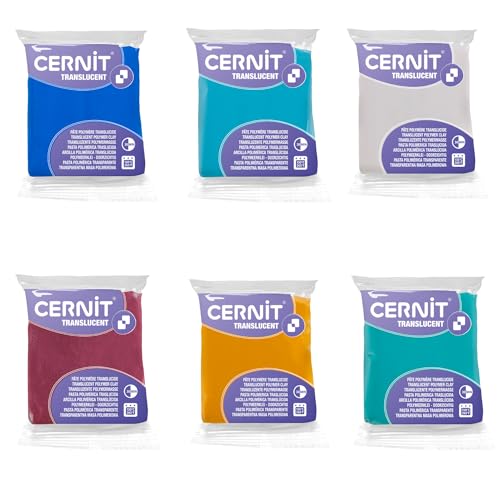
Cernit Translucent earns its place as the specialist for glass-like effects. The six-block set holds Sapphire, Turquoise, Ruby, Emerald, Amber, and White, six shades that cover faux gemstones, sea glass, and frosted ornaments. After baking, the clay reads like frosted glass rather than plastic, and it resists the browning that dulls other translucent clays when a bake runs long.
The clay stays soft and workable before baking and cures to a flexible, durable finish that sands and buffs well. Fresh blocks can feel sticky, so let a new block rest open for a while before conditioning, or work it on a cool surface. Cernit is made in Belgium from vegan ingredients, and the range mixes with other polymer clays that cure at the same temperature.
Specs
- Brand: Cernit
- Line: Translucent
- Count: 6 blocks, 56 g each
- Model: CE9256275AMZC
- Colors: Sapphire, Turquoise, Ruby, Emerald, Amber, White
- Bake: 230 to 266 degrees Fahrenheit for up to 30 minutes
- Finish: Translucent, frosted glass
- ASIN: B0CVBBRFNZ
5. Van Aken Kato Polyclay 4-Color Cool Set
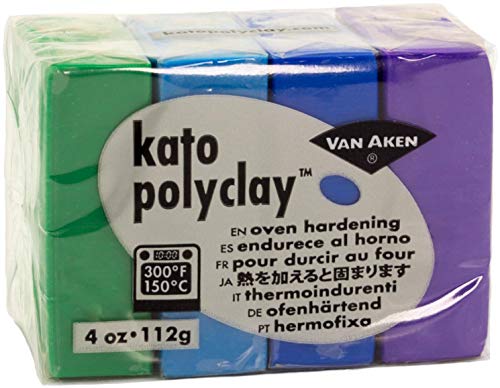
Kato Polyclay is the firmest clay in this guide, and that firmness is exactly what miniature work demands. Tiny food, dollhouse details, and fine canes need a clay that holds an edge through handling, and Kato cures to a hard, durable finish with no bubbles before or after baking. The Cool set holds four shades, Cool Green, Turquoise, Blue, and Violet, a palette that suits ocean scenes, peacock canes, and cool-toned jewelry.
Kato cures near 300 degrees Fahrenheit, hotter than the other clays here, so bake it on its own and confirm your oven temperature with a thermometer. Conditioning takes more effort than FIMO Soft, and a pasta machine helps, but the payoff is detail that survives. Mica shift and hidden-magic cane techniques were developed around this clay for a reason.
Specs
- Brand: Van Aken
- Line: Kato Polyclay
- Count: 4 bars
- Model: VA12142
- UPC: 031002121424
- Colors: Cool Green, Turquoise, Blue, Violet
- Bake: 300 degrees Fahrenheit for 10 to 30 minutes
- Finish: Opaque, hard and durable
- ASIN: B009OOABCU
Who Should Skip These
Skip polymer clay entirely if you want a material that hardens without heat, since every clay here needs an oven cure. Air dry clay suits that need better, and it never risks an underbaked core. Skip the firmest clays if conditioning hurts your hands; FIMO Soft or Souffle will serve you better than Kato. Skip translucent clays if your work is all solid color and heavy texture, since you pay for clarity you will not use. And skip any clay that lists a bake temperature your oven cannot hold steady, because an oven that swings hot can scorch a piece and an oven that runs cool leaves it brittle.
FAQ
Can I bake polymer clay in a home oven?
Yes. All five clays in this guide cure in a conventional home oven at the temperature on the package. Use an oven thermometer to confirm the real temperature, bake on a ceramic tile or parchment-lined tray, and ventilate the room while baking.
How do I keep polymer clay jewelry from breaking?
Bake for the full time at the correct temperature, since underbaking is the most common cause of breakage. Keep earring pieces at least a few millimeters thick, avoid sharp inside corners where cracks begin, and sand the edges after baking for a clean, strong finish.
Can I mix different brands of polymer clay?
Yes, when their bake temperatures match. Premo and Souffle cure at the same temperature, so they combine freely. FIMO Soft and Cernit cure cooler than Kato, so avoid mixing a low-temperature clay with Kato in one piece unless you bake at the lower temperature and accept a longer cure.
Does polymer clay need a sealant after baking?
Not always. A matte finish from Souffle looks finished on its own, while glossy jewelry benefits from a varnish or resin coat that deepens color and protects the surface. If you varnish, test it on a scrap piece first, since some varnishes stay tacky on polymer clay.
Final Verdict
Sculpey Premo Translucent is the best single purchase for jewelry and miniature makers who want one clay that does the most jobs, from canes to faux stones. The Premo and Souffle multipack is the better buy for a maker who needs a full palette at once, and FIMO Soft is the kindest place to begin. Cernit Translucent wins any project that needs a glass-like glow, and Kato Polyclay wins any miniature where fine detail must survive handling. Pick the clay that matches the work you actually make, confirm the ASIN on the listing before ordering, and check stock at publish time since several listings rest on older crawls.









