
Key takeaways
- Five programmable kiln controllers for pottery firing programs: plug-and-play ramp-soak boxes, WiFi PID units, and panel-mount units for DIY builds.
A kiln controller is the part that turns a hot box into a firing schedule. It watches the thermocouple, switches the elements on and off, and walks the kiln through ramps and holds so bisque and glaze firings follow the curve the clay needs. The controllers most potters know by name, Bartlett Genesis and Orton AutoFire, ship built into new kilns or through pottery suppliers, so they rarely appear as standalone listings on Amazon. This guide covers the programmable controllers actually sold there that potters use on manual kilns, converted kilns, and DIY builds.
As an Amazon Associate, we earn from qualifying purchases.
Quick Answer
For most DIY pottery kiln builds, the Auber Instruments SYL-2352P is the strongest choice, with 30 ramp-and-soak steps and an SSR output. For a 120-volt kiln with no wiring work, the Happybuy plug-and-play box is the simplest route. The WiFi Auber AW-SYL-2352P suits remote monitoring, the SYL-2342P fits contactor builds, and the Thermomart panel-mount unit suits long 60-segment programs.
How to Choose a Kiln Controller for Pottery Firing Programs
The first decision is the form the controller takes. A plug-and-play box sits between the wall outlet and the kiln, so a manual kiln becomes programmable without opening a panel. A panel-mount controller is a bare module that goes into a control box with a relay, a thermocouple socket, and wiring. Match the form to the electrical work you are comfortable doing, and never wire a kiln control box unless you understand mains wiring.
The second decision is the output type. An SSR output sends a low-voltage signal to an external solid-state relay, which switches the elements silently. A relay output closes a mechanical contact that can drive a contactor or a small load directly. Either type works for pottery, but the output must match the switching device in the build.
Program depth matters more than the display. A bisque firing and a glaze firing each need several ramps and holds, so look for at least 20 to 30 programmable steps, and 60 segments gives room for slow cooling holds and crystal glaze schedules. Dual alarms are worth having, since an alarm can warn of a thermocouple fault or a runaway temperature before a load is lost.
Finally, confirm the voltage and current limits. A 120-volt plug-and-play box rated at 15 amps suits small test kilns only, while a 240-volt kiln needs a panel-mount controller with a suitably rated relay and breaker. A controller alone does not make a kiln safe, so pair any pick with a working kiln-sitter or witness cones as a backup shutoff, and stay nearby during a firing.
1. Auber Instruments SYL-2352P PID Temperature Controller

The SYL-2352P is the most widely used programmable PID in DIY kiln builds, and it earns the top spot by covering the whole firing job in a compact 1/16 DIN module. It programs up to 30 ramp-and-soak steps, so a bisque schedule, a glaze schedule, and a slow cool-down all fit without chaining programs together. The fuzzy logic PID holds the temperature steady through each segment.
Specs
- Model: SYL-2352P
- Size: 1/16 DIN, 48 by 48 mm
- Programs: 30 ramp-and-soak steps
- Output: 12V DC for an external solid-state relay
- Inputs: Type K, E, S, WRe, J, T, B, N thermocouples and Pt100 RTD
- Type K range: minus 60 to 2300 degrees Fahrenheit
- Accuracy: 0.2 percent of full input range
- Alarms: two alarm relays
- Power: 85 to 264 volts AC
- ASIN: B01DC3KNS0
The 12-volt SSR output is the key detail: it drives an external solid-state relay, which switches the elements silently, without mechanical contact wear. The two alarm relays can guard against a high-temperature fault or a failed thermocouple. One limit is that the box holds only the controller, so a thermocouple, an SSR, a heat sink, and an enclosure must be bought separately.
2. Auber Instruments SYL-2342P PID Temperature Controller
The SYL-2342P is the relay-output sibling of the top pick, and it suits builds where a contactor does the heavy switching. It shares the same 30-step ramp-and-soak programming, fuzzy logic PID, and wide sensor input range. The difference is entirely in the output stage.
Specs
- Model: SYL-2342P
- Size: 1/16 DIN, 48 by 48 mm
- Programs: 30 ramp-and-soak steps
- Output: dry relay, 10 amps at 120 volts
- Inputs: Type K, E, S, WRe, J, T, B, N thermocouples and Pt100 RTD
- Type K range: minus 60 to 2300 degrees Fahrenheit
- Accuracy: 0.2 percent of full input range
- Alarms: two alarm relays
- Power: 85 to 264 volts AC
- ASIN: B07GYZFR2Z
A relay output is the right choice when the kiln already has a contactor, since the controller only needs to switch the contactor coil rather than the full element current. The trade-off is mechanical wear: a relay clicks on every switching cycle, and a kiln that cycles often will wear the contacts faster than an SSR setup. Choose this model when the build centers on a contactor, and the SYL-2352P when it centers on a solid-state relay.
3. Auber Instruments AW-SYL-2352P WiFi PID Temperature Controller
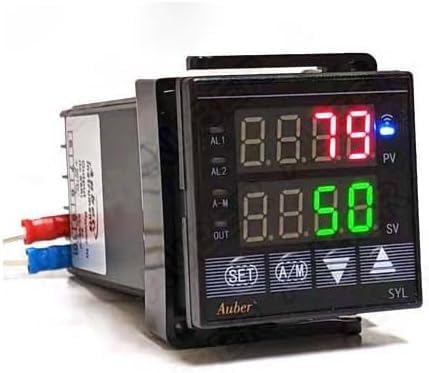
The AW-SYL-2352P adds WiFi to the same 30-step ramp-and-soak platform, and it is the pick for potters who want to watch a firing from another room. It connects through a home router on 2.4 GHz WiFi, and the companion app shows the live temperature, plots the firing curve, and allows the program to be edited from a phone.
Specs
- Model: AW-SYL-2352P
- Size: 1/16 DIN, 48 by 48 mm
- Programs: 30 ramp-and-soak steps
- Output: 12V DC for an external solid-state relay
- Connectivity: 2.4 GHz WiFi, iOS and Android app
- Inputs: Type K, E, S, WRe, J, T, B, N thermocouples and Pt100 RTD
- Type K range: minus 60 to 2300 degrees Fahrenheit
- Accuracy: 0.2 percent of full input range
- Alarms: two alarm relays with push notification
- Power: 85 to 264 volts AC
- ASIN: B0D81J59GG
Remote monitoring is genuinely useful during the long middle of a firing, when the kiln needs hours at temperature. Two cautions apply: WiFi works on 2.4 GHz only, so a 5 GHz-only network will not connect, and remote monitoring is no substitute for being nearby at the end of a firing, when a shutoff fault would matter most.
4. Happybuy Plug and Play PID Ramp Soak Kiln Controller

The Happybuy plug-and-play box is the only pick here that needs no wiring at all, which makes it the simplest way to add firing programs to a small manual kiln. The kiln plugs into the back of the box, the ceramic thermocouple drops into the kiln, and the controller runs the program. It programs 60 segments, 30 ramps and 30 soaks, and measures up to 1300 degrees Celsius with the included Type K ceramic thermocouple.
Specs
- Brand: Happybuy, manufacturer Thermomart
- Model: DTH101-PP plug-and-play box
- Programs: 60 segments, 30 ramps and 30 soaks
- Maximum current: 15 amps
- Thermocouple: Type K ceramic, included
- Temperature range: minus 50 to 1300 degrees Celsius
- Safety: 15-amp circuit breaker, buzzer and flasher alarm
- Display: Fahrenheit or Celsius
- ASIN: B07JKGCJLR
The 15-amp limit is the defining constraint: this box suits 120-volt kilns up to 15 amps and cannot serve a 240-volt kiln or a larger 120-volt kiln. Within that limit it is a complete package, with the controller, the switching, the breaker, and the sensor in one box.
5. Thermomart Programmable PID Ramp and Soak Controller

The Thermomart panel-mount controller is the second 60-segment pick, and it suits potters who want the longest programs in a bare module for a custom control box. Like the plug-and-play box above it uses 30 ramps and 30 soaks, but here the controller is a 1/16 DIN unit with an SSR voltage pulse output, so the builder supplies the relay, the thermocouple, and the enclosure. Its universal input accepts Type K, S, E, J, T, B, and N thermocouples plus RTDs, with a range of minus 200 to 1800 degrees Celsius depending on the sensor.
Specs
- Brand: Thermomart
- Size: 1/16 DIN, 48 by 48 by 90 mm
- Programs: 60 segments, 30 ramps and 30 soaks
- Output: SSR voltage pulse
- Inputs: Type K, S, E, J, T, B, N thermocouples and RTDs
- Temperature range: minus 200 to 1800 degrees Celsius
- Accuracy: 0.2 percent of full scale
- Control: fuzzy logic PID with auto-tuning
- ASIN: B01ELU81PK
The trade-off is that this is only the controller: a solid-state relay, a heat sink, a thermocouple, and a safe enclosure are all separate purchases, and the wiring must be done correctly.
Who Should Skip These Controllers
Skip this whole group if the kiln already has a working digital controller, since a second controller adds complexity without improving a firing that already follows a program. Skip the panel-mount PIDs if mains wiring is outside your comfort zone; only the plug-and-play box avoids wiring. Skip all five picks for a multi-zone kiln, since each one controls a single zone, and a large kiln needs a multi-zone controller from the kiln maker. Potters who want a drop-in replacement board for a Bartlett or Orton panel should order the exact board instead, since these generic PIDs use different cutouts and wiring. Finally, skip the 15-amp plug-and-play box for any 240-volt kiln or any kiln drawing more than 15 amps.
FAQ
Can a PID controller replace the controller on my electric kiln?
It can replace a failed controller only if the wiring, relay, and thermocouple are reworked to match the new unit. A panel-mount PID is a generic module, not a drop-in board for a Bartlett or Orton panel.
How many ramp-and-soak steps does a pottery firing need?
A simple bisque or glaze firing needs about six to ten steps, while a slow cooling schedule or a crystal glaze firing can need twenty or more. A 30-step controller covers most studio firings, and a 60-segment controller leaves room for long holds on the way down.
Do I need a Type K or a Type S thermocouple?
Type K suits most studio pottery firing to cone 10 and is the common choice for these controllers. Type S lasts longer at the top end and suits potters who fire cone 10 often, but it costs more and needs a controller input that accepts it, which all five picks here do.
Is it safe to leave a kiln firing while the controller runs the program?
No firing should be left unattended. A controller can fail, a relay can stick closed, or a thermocouple can break, so stay nearby, use a kiln-sitter or witness cones as a backup shutoff, and check the kiln at the expected shutoff time.
Final Verdict
The Auber SYL-2352P is the best kiln controller for pottery firing programs for most builders: 30 ramp-and-soak steps, a solid-state relay output, and wide sensor support cover bisque and glaze schedules on a manual or converted kiln. The Happybuy plug-and-play box is the best choice for a small 120-volt kiln when no wiring is wanted, and the WiFi AW-SYL-2352P is the best choice for remote monitoring. The SYL-2342P fits contactor builds, and the Thermomart panel-mount unit fits builders who want 60-segment programs. Confirm the listing and the seller before ordering, since several of these listings rest on older crawls, and check the kiln at the expected shutoff time.









